
Today’s guest post was written by Jim Casada.
THOSE WERE THE DAYS:
WHERE IS THE BOY WITH THE SLINGSHOT?
Recently on her blog, “Blind Pig & the Acorn,” my good friend Tipper Pressley offered a piece featuring a song, “It’s Gone Like a Candle in the Wind,” with a video of her brother and late father singing the sad yet heart-warming ballad. This isn’t the song with a similar title featuring Elton John’s tribute to Princess Diana but rather one devoted to lost youth, delayed promises, and a boyhood lived close to the good earth. Verses from the chorus go straight to my soul while capturing so many powerful, poignant memories of old long ago.
Where is the boy with the slingshot?
Who guarded the homestead back then.
And where is the life that I used to call mine?
It’s gone like a candle in the wind.
Certainly it would seem that slingshots, at least of the nature and in the configuration I knew them, have indeed vanished like a candle’s flickering frame caught in the frenzied winds of what some style progress. Yet for several generations slingshots, sometimes known as flips, wrist rockets, or catapults, were an integral part of life for young boys growing up in rural areas. Parents who had known the rigors of World War I, survived the horrible influenza epidemic of that conflict’s aftermath, weathered the woes of the Great Depression, or were adults during World War II, all raised youngsters whose “raisin’” included almost an instinctive sense of guarding the homestead. They also knew the value of a dollar and the virtues of cost-free toys with potential practical uses.
That guard duty meant every red-blooded American boy had to have a slingshot or, in the final decades of the eras mentioned above, possibly a Daisy Red Ryder BB gun. The latter item, however, while perfectly capable of wreaking havoc on homemade paper targets, fence posts, songbirds, and more, had significant problems. Acquisition of a BB gun required cash money, and to make matters even more complicated, they required ammunition available only through purchase.
Slingshots, by way of sharp contrast, could be made from readily available, cost-free materials. Moreover, ammunition in the form of small, carefully selected river or creek rocks, along with pea gravel, was available in endless abundance.
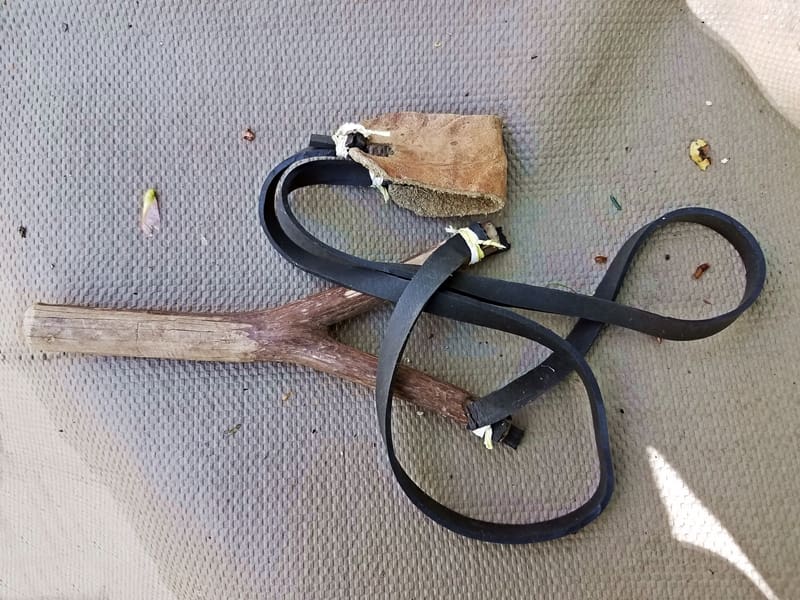
Boys, usually with considerable assistance and advice from their father or grandfather, constructed slingshots on pretty much an annual basis and sent untold numbers of rocks hurtling towards targets. The materials required to craft a slingshot included a carefully selected and whittled dogwood fork or similar wood from some other tight-grained, slow-growing hardwood; rubber from a discarded car or truck inner tube back when tires came equipped with those tubes; a leather patch cut from a discarded boot or other item then softened with repeated applications of Neat’s-foot Oil or some other leather conditioner; and sturdy twine to attach the pieces in rubber to the patch and the frame of the slingshot.
Someone who was really good with a slingshot could shoot them with deadly accuracy and with considerable rapidity. I had two older cousins who lived on a farm near Whittier, Erwin and Merlin Casada, who were flat-out marksmanship wizards. They could cut a corn stalk into with virtually every shot, and any rabbit or squirrel that made the mistake of staying still at distance up to 25 yards or so was in dire trouble. I never reached their level of expertise but I certainly sent thousands of rocks, not to mention somewhat more accurate but costly ammunition in the form of marbles or ball bearings, hurtling through the air. Whenever I struck my target there was cause for celebration, and I was at least sufficiently accomplished to hit a sheet of notebook paper or medium-sized tree trunk with regularity.
My interest in making, carrying, and shooting slingshots wasn’t at all unusual. Many boys carried one in a hip pants pocket as a matter of course, and just like the verses from the previously mentioned song, we guarded our homemade forts, held off Indian sieges, repulsed Nazi hordes, and played “war” with great regularity.
The simple thought of playing war in an outdoor setting in today’s world would quite possibly cause trauma in parents and send a trained psychologist into a tizzy. Yet the sling-shot carrying youngsters of generations past probably had a greater likelihood of becoming stable, solid citizens than is the case of today’s boys using high-tech tools to play video games of a decidedly warlike nature.
I lack the training or knowledge to make anything approaching a definitive statement in that regard, but based on personal experiences and keen observation I can say that growing up making, carrying, and shooting slingshots never had a negative impact on me or any of my boyhood buddies. Instead, slingshots required care and craftsmanship, along with getting out in the woods to acquire the frame for making them, in their creation. They took youngsters to creeks and rivers for ammunition, and shooting them meant roaming field and forest in a healthy fashion.
In short, slingshots furnished meaningful recreation, demanded creativity, cost nothing, and provided a great deal of fun. To me, the seeming disappearance of the humble slingshot from the American scene, truly gone like a candle in the wind, is a matter for sadness and perhaps a bit of sobering thought.
—Jim Casada—Mountain Musings and Memories for October 26 (Copyright 2023)
Last night’s video: First Blackberry Picking – Enough for a Cobbler & a Little Juice.
Tipper
Subscribe for FREE and get a daily dose of Appalachia in your inbox

My daddy still makes and uses slingshots on a regular basis. He’s a pretty good shot with them too. I had a rat problem a while back and instead of coming over with traps or poison he showed up with one of his slingshots and a shirt pocket full of ball bearings to take care of the problem lol. I believe he probably could have got every one of them too if it wasn’t for my dog. Old Mack boy was not a fan of somebody coming into HIS backyard shooting at things and so he kept barking and scaring the rats off before daddy could get em. I have no doubt in my mind that as soon as my little grandson (daddy’s great-grandson) is big & strong enough to pull a slingshot, daddy will be teaching him how to have perfect aim and build them all by himself. Gotta pass on these important skills to the next generation!
I’m reading and posting very late tonight, but wanted to tell of my not having a slingshot. My daddy would be 91 if he was still on this earth, meaning he was a little overall wearing country boy growing up in the 1940’s. He always loved to whittle and made a lot of slingshots that I can remember. One particular one he carved in 1960 for me before I was born. When I was born a girl he put the slingshot up and told mama girls had no business with them lol. I really enjoyed Mr Casada’s post. By the way, I watched your garden video tonight, and your hollyhocks are gorgeous!!
God bless Papaw Tony!
This sure brought back memories of my brother’s making sling shots!
With my boyhood “flips” I shot targets and a few songbirds, and I regret the latter. Robins were much too trusting, and tempting. As a teen and beyond, I shot at squirrels and feral cats. I never hit either, but I made some duck for cover or run like the dickens. As for BB guns, my brother had our only mishap while using one. When cocking the gun, with the stock against his foot for leverage, he shot a pellet into the meat of his thumb–and didn’t realize it until his thumb festered and the BB popped out. He had gone about his business thinking the BB had just scratched his thumb.
I enjoyed Jim’s memories. Thanks, Tipper.
Yesterday I found a book at a thrift store that I thought many Acorns would enjoy. It’s called, “The Jack Tales, Folk Tales From the Southern Appalachians collected and retold by Richard Chase.” I’m guessing many of you would be familiar with the folk tales told in it’s pages!
Allie, how lucky you are to have found that book. I would have considered it my best treasure. Jack Tales are still told in lots of places and are a part of our heritage. If you aren’t familiar check out Ray Hicks. He was a natural. I never heard him in person but thankfully videos are still available. Enjoy your book of tales.
My daddy made them for the kids and grand kids. Usually from a dogwood in the yard.
We didn’t have much to buy with. Had a good time with homemade sleds in the snow or on pine needle hills. We didn’t know how blessed we were. Thank God we will see mama and daddy again someday.
my cousins had them made with good rubber, they work really well, I guess it’s a good thing we didn’t have good rubber, God bless you all and have a great day
The slingshot photo reminds me of a story shared years ago. A little boy opened the Sears catalog on a page with bras shown. He said o boy a doubled barrel slingshot.
I don’t remember ever using a slingshot as a kid but am sure my 4 brothers and my dad did. My sister recently gave me one my dad made. Not long ago I found the video of Rufus Hussey of NC showing his skill with one on the Tonight Show with Johnny Carson. He was amazing! Look it up.
Rook is my 2 1/2 great grandson and so far I have bought him a Case knife, Radio Flyer wagon and a Daisy BB ( with permission) from dad! I do think a slingshot is out of the question for now..by the way we called them flippers back in my day! Why does life have to change from generation to generation??
At first there were the red rubber inner tubes. There were best for making slingshots. They far exceeded the stretch and rebound of the more modern butyl rubber one. If you had a red one you treasured it because “they don’t make ’em any more!”
I think the red ones were made of natural latex, but don’t hold me to that. The butyl inner tubes worked better in tires, or so they say, so they ignored boys with slingshots. Where they not boys once? Or were they not allowed to be.
Hey good stuff but some girls made and used them too. My wife Pat Duffey, 95 from WV will attest to that!
I wished I had a nickel for every slingshot my daddy made for me and my siblings. Fun times.
Girls made slingshots too, used them just like the boys did, and proved to be better marksmen in some cases. Pinto beans made great ammunition for girls who didn’t want to kill birds but could prove their skill by shooting Mimosa flowers off the trees. I will never forget finding and using a slingshot and pebbles while visiting my mom’s aunt Mary. I was aiming at a bumblebee about the time Daddy came walking around the bush where the bee was perched close to the ground. Daddy didn’t spank or scold me for shooting him, but that welt on his ankle hurt me more than it did him.
Yes! My daddy made me a slingshot when I was five years old. (If my name doesn’t come up, I’m a girl!)
Loved this article! Jim has a wonderful way with words. I could visualize each scene. My only memories of slings or a slingshot and Red Ryder BB guns are from the Bible, TV and movies. When Jim was talking about having a slingshot as a boy, I thought about David and Goliath and I also thought the Andy Griffith episode that I think is called “Opie, the Bird Man where Opie accidentally killed the momma bird and Andy. makes him raise the baby birds. I also thought of the movie “A Christmas Story” where the boy in the movie wants a Red Ryder BB gun for Christmas and keeps getting told “You’ll shoot your eye out!”
By the ages of 7 and 10, my two children knew how to load, aim, shoot and unload both revolvers and rifles. Both knew the rules of safety when handling firearms. Both could shoot good but not great. But then they were both little girls still playing with dolls and having tea parties.
Richard, I never hid my guns from my 2 children or 2 grandsons, I would always at least wipe my gun off when I came in from hunting and let them help me clean them if they wanted too. I was trying to teach them gun safety and satisfy their curiosity about guns all at the same time. My son goes to a lot of gun shows and was one time asked by a dealer “who taught how to be safe when handling a gun.”
My 8 year old son has a daisy sling shot. We started him with a bag of beans for his ammo and now there are bean plants shooting up all over our yard, lol! He’s not got past the shooting at targets stage but maybe one day he’ll be able to hunt with it. He also got his first Red Ryder BB gun for Christmas. It certainly is harder to find boys for him to play or practice with these days when all the other boys are inside on their switch
Yep, I was a young member of the Slingshot Brigade. Jim didn’t mention getting ammo from the gravel county roads. But I suspect tons of rock get gone a few ounces at a time back in the day on those backroads. Good ammo was hard to find, for every one good piece there were maybe 10 so-so ones. Anyhow, packing a slingshot was a ‘coming of age’ and ‘rite of passage’ for my brother and myself. Even Dad carried one deer hunting. He would use it to shoot into cover from cliff tops to get the deer to move. I think Jim might agree that for country boys in Appalachia anyway the slingshot was “iconic” of boyhood. By the way, it was not incidental that the young shepherd boy David had his sling when he went to the army camp. It was part of his stock in the trade of being a shepherd and it was never far from him. Just how he killed a lion and a bear is not told in detail, but I think his sling was involved.
Ron, nothing to do with slingshots but gravel roads, did you ever try to walk barefooted on a gravel road in the south in the summertime when it was so hot the tar had melted and would be coming up between the gravel?
No, never did Randy. Kentucky didn’t have that situation. At one time though, I could run barefoot on a gravel road.
I still have my father’s wrist rocket from his boyhood adventures. Thank you for posting this story. Now I have to go practice with it!
I love your post this morning. When I was growing up, the local boys would get together with toy guns and play cowboys and Indians or cops and robbers all the time. Lots of boys had BB guns, and I am sure they had slingshots too. Hubby said his dad helped him and his brother make slingshots. He took our daughter and son hunting with him. He made sure they both got a BB gun for Christmas and he taught them how to safely use it. Children get in trouble on school playgrounds if they use their hands to pretend cowboys and Indians or cops and robbers. The world is such a different place. I wish it was more simple—like it was when I was a kid.
Brenda, I started the first grade in 1960 (no kindergarten in country schools), up until the third grade the boys would ride the school bus and take their their toy pistols to school and play cowboys and Indians or cops and robbers at recess. After the third grade we started playing softball. Most boys carried pocket knives all the way through school. Nowadays you would probably get expelled for even taking a gun magazine or catalog to school…what changed?
So wonderfully written and indicative of the life that so many of us “seasoned citizens” lived as children. It so reminds me of a song written and performed by Billy Dean titled, I MISS BILLY THE KID. In truth, don’t we all miss, at least to some extent, the childhoods we were blessed with? And, as parents, grands, and greats, shouldn’t we all put just a little more effort into making certain that the generations behind us have a childhood memory to latch on too, to cherish and reflect upon? One with the same fondness as we do those that transport us back to our childhood in but a blink of an eye? I say, yes. And so, let us all. Blessings y’all.
The boys always had sling shots to hunt rabbits and squirrels. They would shoot at anything. lol I wish I had some of that cobbler. I miss our blackberries.
My husband had slingshots as a kid and got pretty accurate with them. I don’t know if he hunted with them but I do know he shot his brother and I’m sure his brother got him back!
“That guard duty meant every red-blooded American boy had to have a slingshot or, in the final decades of the eras mentioned above, possibly a Daisy Red Ryder BB gun…” Just make sure that you don’t shoot your eye out, kid! 😉
My thoughts went there as well.
I never had a good slingshot, Daddy tried making me some but never had any good real rubber for the bands. I did get a Daisy BB gun when I was not much more than 6 years old, but often times I didn’t have ammunition for it. My gun was not the more expensive Red Ryder but a cheaper lever action model similar to a Red Ryder. It was not very strong and I soon learned to shoot at card board boxes, the bb would only go through one side and fall inside, I could use these bb’s over and over. I would expect a tube of BB’s didn’t cost much more than a dime back then, but even a dime to spend on something like BB’s was hard to come by for my family.
6 years old and having a gun that would actually shoot and hurt someone, my Daddy would sit me between his legs and let me pull the trigger on his 22 rifle when I was not much more than 3 years old. This was not unusual in my generation, we were raised around guns and taught often times by a belt or hickory switch gun safety. Daddy wouldn’t even let me point a cap pistol at anything alive.