
Today’s post was written by Paul.
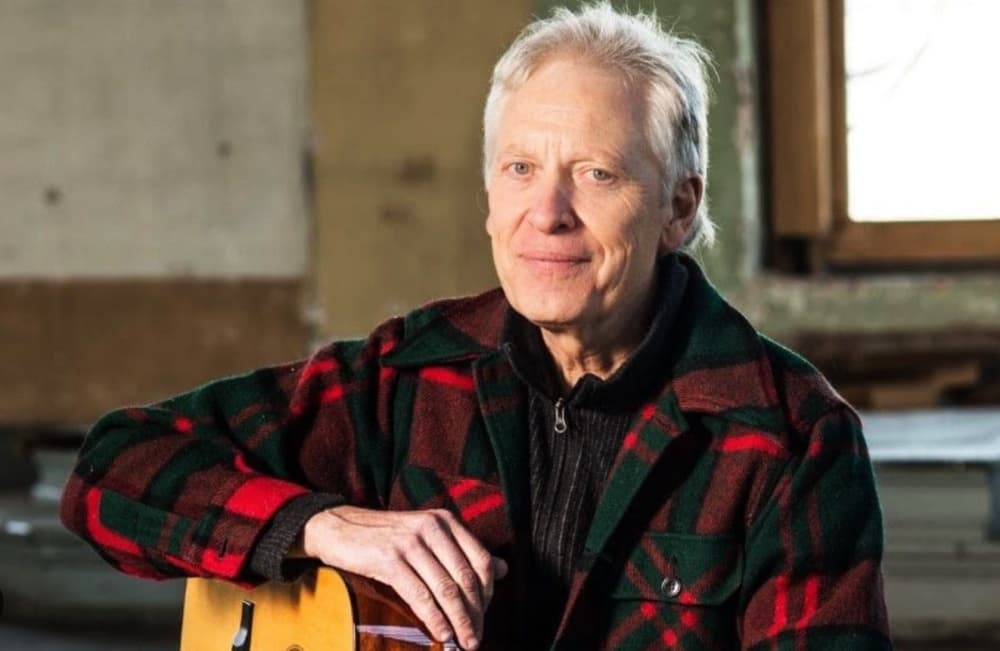
I’ve been sharing a series of videos I filmed with Rob Tiger on YouTube. Rob is an amazing song writer, singer and musician. He lives just up the road from us in Hayesville.
In today’s post I’m sharing a video of Rob’s original song “Lightnin’ Road.” I apologize that my camera placement failed to capture the neck of Rob’s guitar. I know that many of our Acorns (understandably) like to see the musician’s fingers on the neck of the guitar.
I loved Rob’s finger picking and rolls he used at the start of the song, but I loved even more the strum notes that he hit later in the song, in the middle of the neck. They created a cool, dark vibe that matched the subject/content of the song.
In the video, I referred to that part of Rob’s playing when I asked him about “D positions” in the middle of the neck. I worded it that way because to me, it appeared like he created those sounds by moving the D major chord position to unusual parts of the neck.
Rob explained that it was a banjo technique that he transferred to the guitar. Whatever it was, it sounded great, and I wish the camera had allowed you to see it.
Rob’s chance encounter with Doc Watson is fascinating (he tells about it after the song.) I can just picture Doc speaking up to intervene when he heard an eleven-year-old Rob struggling to tune his banjo, fighting against the fluctuations of the natural cat-skinned banjo head in the humidity and heat.
I did a little research into Roger Sprung’s band that Rob mentioned, as it would have been configured for touring in the early 1960’s, and I think it’s possible that rather than Ferlin Husky, the other band member that Rob is recalling from that childhood memory is instead Roy Huskey, Jr., who played bass for Sprung around that time (according to Google).
Roy Huskey, Jr. is a legendary bass player. I first learned about him from a song that the great mandolin player, Sam Bush, wrote and sung about him. The name of the song is simply “Song for Roy.” Bush chose to immortalize Huskey in an original song because he was friends with Roy and because Huskey sadly died from lung cancer at the early age of 40.
Although Rob’s memory of a brush with musical greatness is primarily about Sprung, Watson, and Monroe, it’s worth pausing a little here to discuss Huskey.
Listeners, perhaps especially non-musicians, can take bass players for granted, but a good bass makes an enormous difference in the overall sound of a band. Even here on the BPA channel, where our music is pretty simple and we focus more on vocals, the videos with Tipper or Perry playing bass always sound much better than the videos with only guitar.
In “Song for Roy,” Sam Bush commented on the unique and powerful sound that Huskey could get from his bass. If you give the song a listen, here’s some musician lingo/knowledge that it might be helpful to know: Kay manufactured some of the most popular upright basses from 1930-1960, so when Bush sings, “the boy could slap a Kay,” he basically means that Huskey could really play a bass well, even when he was just a boy. A line in the chorus says, “run the numbers, here’s the time.” That refers to a number system used by most professional studio musicians, which helps them learn new songs very quickly.
One of the YouTube comments on Bush’s studio cut of the song pointed out that it has no bass in it, which is pretty poignant. I guess they couldn’t decide who would be the most fitting bassist to play that part, or maybe some bass players declined out of respect. Either way, it was a cool tip of the hat to record the song with no bass. You can hear the song here.
In addition to Sprung, Huskey played bass for an amazing array of famous musicians, such as Allison Krauss, Alan Jackson, Dolly Parton, Ricky Van Shelton, Travis Tritt, and many, many more. For a more comprehensive list (though not exhaustive), go here.
It would certainly have been cool for Ferlin Husky to have played bass with Doc Watson and Roger Sprung, but it was most likely Roy Huskey, Jr.
Ferlin Husky had a #1 hit song in 1960 (“Wings of a Dove”), so he would probably have been busy with his own touring in the early 60’s.
Just to round out my research, of course, I had to check to see if Roy Jr. and Ferlin were related. They were not, though Ferlin dropped the “e” from his last name some time after he started in the music business. Ironically, Roy Huskey, Sr. played bass on some Ferlin Husky recordings! Small world! But again, they were not related.
Lastly, according to my Google searching, the blind pianist that Pap and I met in Raleigh, who was playing with Arthur “Guitar Boogie” Smith, was possibly Don Ange. I didn’t mention this to Rob, but when Pap and I walked up and spoke to him, he said to Pap, “You’re the tenor singer.” He could tell from Pap’s speaking voice which part he had sung in the songs they performed. We thought that was pretty cool and another demonstration of how his sense of hearing was perhaps especially sharp due to his vision loss. Arthur Smith co-wrote “Dueling Banjos” with Don Reno.
Paul
Original singles released on Spotify.
Shepherd of My Soul (Album released in 2016).
The Wilson Brothers Words of Life Album released in the 70s.

Both today’s song and my comment mention 41 and 49 Fords. The reason for Fords was their famous V8 flathead engine built from 1932-1953. These were the favorite of both racers and moonshiners that had a need for a fast car. A mechanic in Atlanta, GA (Red Vogt) became famous for building these engines for racers, moonshiners and even law enforcement. I read about him being asked who would get the best or fastest engine, his answer was “ money equals speed” in other words whoever was willing to pay the most money.
Anybody remember Roy Drusky? Second Hand Rose, Jody and Kid, Red Red Wine?
Junior Johnson?
TY Paul. I enjoyed this post and video.
Well I L B, you sure know a great deal about music and musicians, Paul. I wouldn’t even be up to the 11-year old Rob. I’m amazed at the different people you have as guests that are from your ali’s neck of the woods. Evidently the North Carolina and neighboring South Carolina, Georgia and Tennessee mountains are just full of talents of all kinds.
Ron, I can’t play a radio without getting static!
The song reminds me of a story I read of a man in my area driving a 49 Ford making a moonshine run on Saturday nights but was never caught by the Fed’s. It was said his mother would kill a hog on Saturday morning and the jars of moonshine made on Friday night would be put in the lard cans and then the hot lard poured over them. When the lard cooled and harden you could not see the jars and it also kept them from getting broke. The Fed’s never figured this out. The local law was bought off and anyone else that knew didn’t talk. I hear his relatives are still building fast cars and racing at the local dirt track on the weekend.