
Building loose haystacks
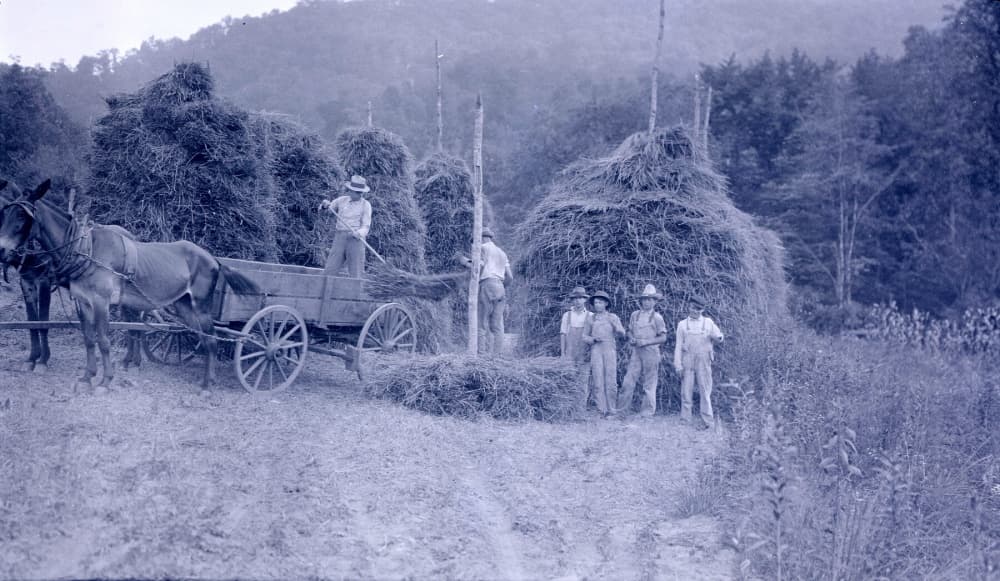
Two men pile up hay in a loose stack around a large stick to make haystacks. One man stands in a mule-drawn cart pitching the hay onto the stack and the other helps. Four boys stand to the side with completed haystacks behind them. The photographer, “Doc” Kelly Bennett (1890-1974), was a prominent pharmacist in Swain County, NC. Owner of the Bryson City Drug Company, Bennett served as alderman and mayor of Bryson City, on the Swain County Board of Education, as well as several terms as NC State Senator and NC State Representative. He participated in numerous other initiatives and organizations. Known as the “Apostle of the Smokies,” Bennett was an instrumental figure in the movement to create the Great Smoky Mountains National Park. He was also an avid photographer, skillfully documenting a wide variety of people, places, and events in Swain County and the surrounding area.
Creator
Bennett, Kelly, 1890-1974
Location
Swain County NC
—Southern Appalachian Digital Collections
Folks in my area have had a time getting their hay in this year because of the ample rain we’ve had.
Putting up hay has changed a lot since I was a girl. I remember Whitmire cutting hay on his large cattle farm that borders Wilson Holler. He’d hire local boys to help him and you could see them out in the field— hot, sweaty, and I’m sure itchy as they threw the square bales onto the back of a slow moving truck. These days its all the large round bales that have to be moved with a tractor.
When Pap was a boy they cut hay by hand and piled it in stacks like the men and boys in the photo. Pap said they only cut hay once a summer in those days. As time went by and things advanced in the mountains of western NC Pap’s family used a cutting machine that was pulled by a team of horses to cut hay. Pap said when that happened they thought they had hit the big time. Cutting hay with a machine and horses was easier and it was so much faster than cutting by hand.
A rake behind a horse or mule was used to pile the hay and pitchforks were used to throw it on the back of a wagon. If you were lucky enough to have a big barn, Pap said you stored the hay in the loft.
Folks that didn’t have a barn or needed more hay than the barn would hold, would cut a small tree, four or five inches thick, and cut the limbs down to where they were short and stubby. The tree was placed in the ground and the hay was thrown around it into a pile of sorts. Pap said the hay actually lasted pretty good with the tree method, not as good as inside a barn, but good enough to provide for the animals.
Years ago Bass Hyatt told me when he was a boy living in Brasstown the hay had to be replanted each year. The type of spreading creeping grass we have today hadn’t been introduced in this area so the fields had to be harred and the seed put in the ground each spring. That was an extra burden placed on top of the whole cut it by hand part. Bass said “My daddy taught me to pile the hay in a tall stack and I did it enough that I got pretty good at doing it.”
Last night’s video: June Garden Tour.
Tipper

I’ve mowed with the old horse drawn cycle mower and raked with the hay rake when I was so light I had to stand to trip the rake. We stacked it in “shocks” in the field to make it easier to load on the wagons. Any we couldn’t get in the barn was stacked around a pole. I was so glad when a neighbor bought a baler and came to bale our hay. Even though there was still hard work involved this was so much easier.
I am late to the comment party today, but wanted to add my two cents. Horse drawn farm equipment demonstrations can still be seen at the Amish Horse Festival. This annual showcase, now in its 31st year, rotates between Amish settlements in Pennsylvania, Ohio, Indiana, Illinois—and now, for the third time, Clare County, Michigan. Last year’s event took place in Gordonville, Pennsylvania, and drew thousands of attendees. I have always wanted to attend one, but I have never been in the right place at the right time.
When I first settled in North, Georgia 10 years ago, several of my newfound friends (all ladies of a certain mature age) got together to help two of the ladies get hay for the winter for their horses. I am right proud that six of us managed to throw enough bales to load two very large flatbed trailers and unload them into the barns. None of us were worth much for a few days after that but we all had a great time. We are all now approaching our 80’s and we each have a picture in our homes of all of us perched on the bales atop the trailer.
Awfully hard work! My husband did square bales with his uncle when he was in high school. He said it’s the itchiest, driest feeling after you’re done. We buy our hay now in big round bales, but I sure would have liked to see the old way of doing it. I know my kids would want to play on it like Laura and Mary in the Little House books.
That shore is some awful coarse looking hay. Them looks more like brush piles than haystacks don’t they?
I am from Swain County. I have seen many haystacks made and participated in some but none like that. We stacked our hay around a pole much like a thatched roof goes on. A relatively thin layer on the outside sheds off water and protects the inside. The hay goes on vertically and is “combed” with the back of the pitchfork to bond it all together.
Tunneling under a haystack was strictly forbidden but if you could blend your doorway in with the rest of the stack nobody would notice. Haystacks are warm inside all winter and smell good too.
Hay is hard work, no matter how it’s cut and gotten up. Very interesting picture of the hay stack method.
Couldn’t add much of anything to what has been posted already today. Might just say working hay as Randy describes it is also somewhat like hand loading pulpwood . I know Randy knows about that. At least “bugwood” is not so blamed itchy and dusty. Like Randy, don’t recall ever seeing a haystack around a hay pole. On our place the size of the hay field and the size of the barn were a match. I will say that in my opinion having done hard manual labor as a teen has lasting benefits for life. Once having known the feelings of hard, hot, dirty, dusty, itchy, achey work plus the satisfaction afterwards of a job well done — you never outgrow knowing you have done it and can again if need be. I sure have mixed feelings now when I see those horse-drawn mowers, hayrakes, plows, etc used as decorations. Sad somehow about passage of time and change. I belong here less and less.
Ron, I think it would be safe to say, both of us have been there and done it. Learning and doing to do work like this in my teenage years and earlier years of my adult life taught me the work ethics that I had during the working years of my life. I am sorry if this sounds like bragging, the last supervisor I had before I retired said this to me “I’m sorry I don’t get over to speak to you every morning, I have to babysit some of the others, I know if I am not hearing anything from you, everything is being taken care of. There would be no need of me, if all of my workers were like you.” Now I am paying for a lot of that hard work, I inherited arthritis from my mother’s family but also have some bad disc in my back. I like to joke and say if I knew I was going to inherit this stuff, I would have been more careful about who my parents were. I also say hard work may not kill you, but it can sure break you down! After running some errands this morning with my son’s help, I am now hurting like I would if had a fever and the flu.
No, I don’t call that bragging. You didn’t say it about yourself – someone else did. What he said about you was true of many, probably most, of the Appalachian folks – or I think I might should say Southern – who moved north to work in the Rust Belt. Fit my Dad for one.
Good morning, Tipper. Interesting picture and read. I have never been around any haying time, nor ever seen a haystack, (just the round bales so common these days) but I have read many stories from back when that was a way of life and I have known some who were a part of the ‘doing.’ My oldest son, as young lad, tried it one summer but as he has allergies, he quickly found that it was not the job for him. That photographer, Bennett sure was an ‘all around fellow’ who seems he could do pretty much anything he had a mind to!
Love your post and the old picture this morning. My sister and I spent many summers helping my dad get hay. One summer I learned to drive the tractor through the field while others threw the bales onto a wagon behind me. We also helped throw the square bales up on a big wooden truck bed while dad drove. There were always lots of neighborhood boys helping too. My sister and I were the only girls. We were such tomboys. We all worked putting up hay in our neighbors giant barn. We did not get paid, but we did this so we could have hay we needed for our milk cow or a calf we would raise each year for butchering. I definitely remember being hot and itchy. I also remember dad letting us sit on top of the bales as he drove to the barn. I can’t believe we didn’t fall off.
Oh boy. Hauling square bales of hay. First thing i would do is remove my shirt b/c i couldn’t stand its sticking to me. After stacking that stuff in a tin roofed barn it hot weather, cold tea or water was phenomenal!
I can still hear the old sickle mower my dad’s team pulled and the sound the hay rake made as he pressed the lever which raises the tines to release the hay as he raked. I “helped” him throw the hay on the wagon with pitch forks (or in my memory I helped but in reality I was probably not much help). I took a picture of Daddy resting his team with him sitting on the rake. He also had a flat wooden frame for the wagon that extended the bed all around so he could get more loose hay loaded. I often think of the lesson he taught me about piling loose hay. That is, to first pile it around the edges and then fill in the middle. That way less fell off. I have a picture of the hay stack like you are talking about on my grandparents’ farm but I don’t remember Daddy ever having them. He used the barn loft. It amuses me to see short-handled thick-tined potato forks called pitch forks. It is obvious those people who call them that never used one. Sometimes my uncle baled square bales for us. I recently passed a field with larger “square” (rectangular) bales which looked like about three times the size of the normal ones. My first thought was that I wish I could see the baler used to make those. Round bales are more prominent in my area of southern middle Tn. Being in an agricultural area, I do see some teen workers with the old work ethic but not as many as there used to be. Thanks for allowing me to share random thoughts and memories.
I remember haystacks from my youth. A neighbor had a couple that his old cows completely ignored. Then he put up a rail fence around them, that the cows could barely squeeze through. Within a few days the stacks were gone. I remember seeing somebody use the old horse drawn mowing machines; ground driven. Now some places use them for nostalgic decorations. The rakes would drag the hay in the field up to a pile to load onto a wagon or in later times, to pitchfork into a baler. For a long time i looked for an old one row horse-drawn cultivator. Finally found one, now it’s put aside until i can clean it up, paint it, and display it by the road.
If you want excitement in the hay field, run over a yellow jacket nest in the ground with a pair of mules pulling a mowing machine. I witnessed this several times growing up and it is exciting but very dangerous. The driver can’t get off and just tries to hold on and get control of the mules who go wild while being stung. On a mule drawn hay baler the loose hay is put into a chute and tamped down and compressed with a cylinder as the mule walks in a circle to activate the cylinder. To make the bales a proper length a wooden block is dropped into the chute .This block has two slots through which the baling wire is inserted and goes to a second block , inserted and tied off to give y0u a completed bale. When I was 5 years old Dad had me tying off bales. It wasn’t hard work but hot as the baler was in full sun all day. The only time I have had heat exhaustion was stacking hay in a tin roofed hay loft, at 16 years old. It took a special mule to walk the circle to pull the baler plunger, not one that was excitable. In tying off the bales you might witness a part of a snake embedded in the hay bale who had been sliced up by the mower. This could catch you by suprise, make your heart rate escalate. In my area at a fall celebration sometimes a demonstration will be given of a mule drawn baler or mule drawn sorghum mill. This is something that is interesting to young people but they still don’t understand the hardship that took place. The Dyer County fair at Dyersburg usually has the sorghum demonstration and sell the molasses they produce. Randy I dug post holes for my uncle for 10 cents per hole including setting the post and tamping the dirt around the post to stabilize them. The post setting is another skill, not as easy as it sounds if done right, another subject for another day.
Running over a yellow jacket nest while harrowing, bush hogging, mowing, etc is a sure fire short term cure for arthritis and other aches and pains. Yellow jackets stinging you will make you forget about all of those aches and pains! I have set post too, my Granddaddy and others would put sand back in the hole instead of dirt, after the sand was packed down, it was almost as good as cement. You mentioned mules, my Grandaddy would always tell me to never wrap the plow lines around your wrist or tie them together and hang them around your neck, because if something spooked the mule it could drag you to death.
I love reading stories like this. I’d never heard of making tall haystacks like the one pictured. I’m curious what “”harred” means. Couldn’t find a definition anywhere.
Pam, so glad you enjoyed this one! Here’s a post that explains it well: https://blindpigandtheacorn.com/appalachia-through-my-eyes-its-time-to-har-the-garden/
Pam, it’s the old country vernacular for “harrow”; like “wheel bar” for instance.
guessing “harrowed”
reminds me of first quarter in college, doing a writing assignment, I was quoting my mom who said she would do something “drekly.” Took me forever to realize she was saying “directly.”
I have a a very good friend that was raised on an Iowa hog farm. Instead of harrow or harred he would say disc. July 5th will be my Daddy’s birthday, it will also be the anniversary of the death of this friends 12 year old son that was burned to death in a cabin fire. The youth group from his church was on a retreat. Both of these things happen in 1991.
What does “so the fields had to be harred” mean? I’ve never heard that term??
Darlene, thank you for reading! Here’s a post that explains it well: https://blindpigandtheacorn.com/appalachia-through-my-eyes-its-time-to-har-the-garden/ 🙂
How fortunate to have such a wonderful documentarian as Mr Bennett. I’d love to see more of his photos.
Very common site in my day. I lived in Sevier County and granddaddy would have several of the neighborhood men help him. Daddy let us kids (even us girls) help one time. We begged of course. That loose hay was piled as high as the mountain on that wagon. The men stood ready to stack it around the hay pole when his mules Old Kate and Tobe cut a sharp right and the wagon turned over. Granddaddy was so tickled seeing all these bodies shooting out of that hay. I sure didn’t think it was funny and me and my sister Charlesetta never asked again if we could help put up hay. It goes right along with putting up tobacco. It is the hottest and the hardest work I know of. Hope everyone has a blessed 4th and remember to pray for our soldiers, Israel and our country. We have a grandson serving.
Hard work and interesting historical information about hay stacking in NC. I watch a YouTube homestead channel that recently the father wanted to teach his teenage sons how to harvest hay by hand. The field he has is very large but him and his 4 teenage sons did it. They were in rhythm with each other the entire time. Hard work but they all seemed to be thrilled with their success in harvesting the hay. They let it dry out on the ground, then flipped it over to let the other side completely dry before stacking it on logs and covering it for the winter. It was a long couple of weeks to process it all, but they edited to shorten the time lapse so it was in one video. I was shocked how much they all seemed to really enjoy the process and plan to do it again next year.
I still remember the itchy itchy itchy after helping with the hay one summer. We were so sweaty it all stuck to us!
It’s hard work. My husband worked one summer baling hay and harvesting tobacco in Kentucky when he was a teenager. He says he knows he’s not cut out for more than hobby farming because of that summer haha.
I have never seen haystacks in my neighborhood. I am sure it was done, but it was before my time. I have seen many mule drawn mowers and hay rakes on some of the old farms that would back this up. I begin to try and help farmers get up their square bales of hay when I was about 12 years old and continued doing this on into the early adult years of my life. If you want to experience hard, hot, miserable manual labor work, help pick up square hay bales, stack them on a flatbed trailer or wagon, then throw them in up into the barn loaf and restack them under a tin roof barn during the hot summer months of July and August in the south. After doing this, it made getting in a creek a pure tee pleasure. Nowadays the teenage boys that would do work like this are few and far between. They don’t have to work and make their own money like the teenage boys of the past generations did, now everything they want is given to them. Tipper and me both say boys, I know of some girls that would help by either driving the trucks or tractors, while the boys were loading the hay bales. I have heard the agricultural departments are trying to do away with round bales of hay, they claim cows have not had a “square meal” since the farmers went to the round hay bales.
Another way for teenage boys of the past generations to make money was to dig post holes for farmers with the old two handle hand held post hole diggers for 10 cents a hole.
Randy, I enjoy your comments very much. Thanks for taking the time every day to write such thoughtful and insightful comments.