
Matt haring the garden
When we first bought our place, what was once a large garden spot had grown up in brush and little saplings. We bought in August so my husband found a distant neighbor to come along with his disc.
He cut deep into the ground and broke up all the saplings, berry, honeysuckle and weedy overgrowth. The big lumps turned up like rows of little mountains with all the brush sticking root up.
Over the winter it froze, thawed, froze again and got drenching rains sometimes…Very early when it first dried the farmer showed up with his plow and har…He cross plowed the disked ground and let that new turned ground dry a day or two…By that time we were chompin’ at the bit to plant a garden on our new place…Finally the day came.
He had left his har laying by the garden…here he come attached his har and went over and over going crosswise and row wise…back and forth and so on…Seemed like he done that for hours…Finally I heard the engine on the tractor turn off.
The better half was just patiently waiting napping on and off in the shade to the hum of the tractor…When I went out there, he said that we “ort-er” have a great garden since he worked it over real good…and he did….and we did have our best first garden, the plants grew by leaps and bounds and just kept producing all summer…..Maybe because in some way it was considered new ground….or maybe because this wonderful Christian farmer said it would and blessed it many times with his plow and har….
—B. Ruth 2018
1972 Graham County 50 With the first stages of early clearing, the farmer did “patch” farming near the cabin. Many farmers today still speak of a “patch” of corn or other crops. The farmer gradually and systematically extended the patches into wider fields by each year extending his farming into a new area known as a “new ground.”
—Dictionary of Smoky Mountain English
Last night’s video: Picking the Last of the Blackberries & The Best Dill Pickles Ever (I Hope!).
Tipper
Subscribe for FREE and get a daily dose of Appalachia in your inbox

I love words and variations of words, because of regions, education, life styles, etc.
Hi Tipper and Acorns. I miss my days in the corn field and tater patch. I’m behind on my blog readin’. Ed has been in the ER twice this past week. He feels some better. I’m exhausted. I won’t repeat what that good, Christian doctor during the second visit said to me. I can only hope his medical opinion isn’t what GOD has planned. Please pray for Ed. He needs comfort and easy days. Pray for me as I cry and hang on by my faith. I keep all of you here and up Wilson Holler in my prayers. I love y’all.
I’m sorry Barbara! I will keep praying for you both!
Lord.. y’all tickle me… I can remember ridin’ on a hay rake when I was bout eight I recon… Daddy built up the frame with wood blocks so my feet could touch it and strapped me on that metal seat with a belt. He pulled that thing through the pasture with our old Chevy truck cause we didn’t have a tractor. Funny thing is I wasn’t a bit scared probably should a been but not me especially if I was working with my Daddy. The tractors came later and he had me on ‘um right off so believe you me I know all about disk and harrows , got a harry (that’s what we called ‘em) up in the woods on my place now but not a tractor in sight to pull it with. But then again I got his 99 Silverado sittin’ the drive way wonder how that’d work? I’d give bout anything to be out in a field with my sweet Daddy again even for an hour or two.
I was as crazy over my Daddy as Tipper is over Pap… still am and he’ll be gone 10 years this October. The day before my Momma died… she told our preacher “me and my girls are close and we love each other but they’d fight you for their Daddy “ and she was right….
We always had a big garden and also other areas that were called “truck” patches. They were often for watermelon and cantelope and sometimes peanuts. I finally learned that “truck” patch meant produce for sale. Don’t remember any being sold but we always had wonderful melons. Can’t do it now–no matter how much straw we put under each fruit, they always begin to decay before they are ripe.
Wanda, my Daddy was never able to fulfill his dream of having a “truck garden” and selling produce when he retired. He had his first heart attack when he was 59 and another one that he was not expected to survive at 63 but did live until he was 69. I have not heard the word “truck” used for this meaning in many years.
My patch of green beans will have enough to pick next week; I grow Blue Lake bush beans. Never have been a fan of half runners.
Tipper, I am always amazed with the new content you come up with every day. You must prepare days in advance to come up with new content every day. What would stress me out obviously brings joy to you and I appreciate you so much!
The excerpt from the Dictionary of Smoky Mountain English is troubling. Firstly the use of the word “cabin” leads the uninitiated to believe that the fine people of Graham County all lived in cabins at some time. Why cabin instead of house or home?
Secondly, do the authors apparently did not realize that less than 2% of the land in Graham County today is arable. Dwellers there in bygone times tilled the land that was available to them. The possibility of expanding a developed plot (patch) was nigh impossible. Their only choice was to seek suitable land in other places on their property. Swain County has even a lesser percentage. Most of its arable land was taken by the federal and state governments or were flooded by dams to provide electricity to Tennessee. Cherokee and Clay Counties do a little better but not by much. The idea of just going out and expanding a garden or field in these places is laughable.
Sorry, I’m a little grumpy today!
Good morning, Tipper! We live out in the county so have lots of land that we could work up for new gardens and after reading B.Ruth’s memories I would love to get out and make a new garden bed! Right now I have a fairly large garden and four raised beds which takes up most of my time weeding them. So I wonder would I have the extra time to weed more garden space, maybe! I’m no spring chicken so I need to take a few extra breaks between weeding the rows now. Hmmm, something to think about for next year. I really enjoyed reading B.Ruth’s post as I do all of them! Have a great day everyone!
Good morning! Thank you for sharing the wonderful garden memories from B.Ruth !
Blessed indeed ! Love & prayers for all !
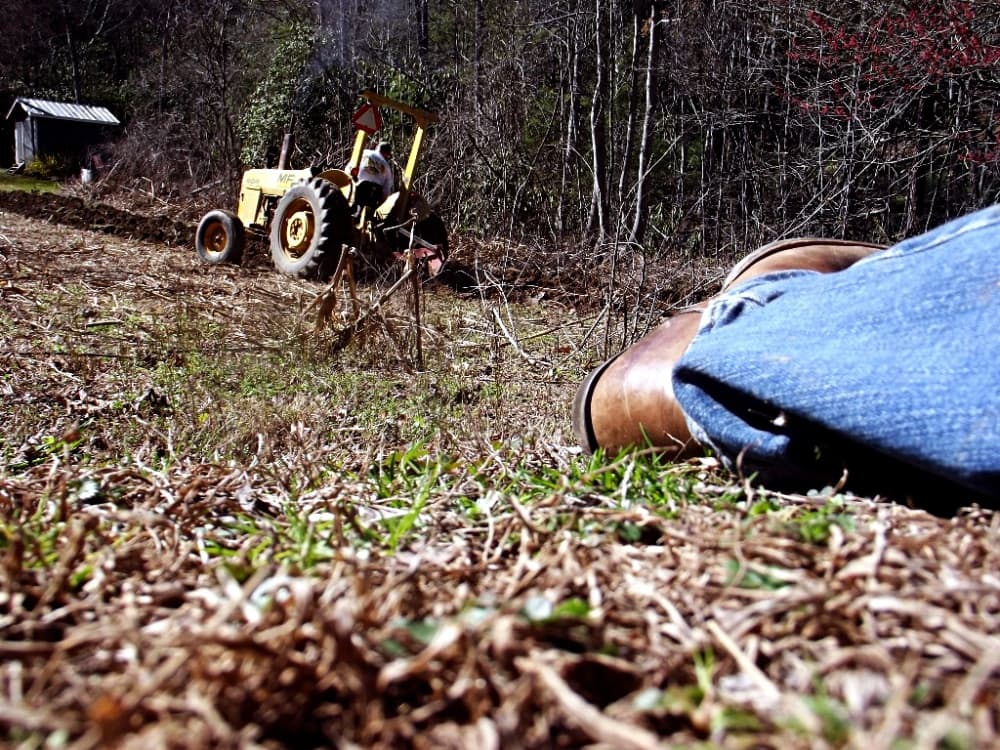
Maybe I’m out of my league and maybe my understanding of “har” is different than most. What I see in the picture is a man on a tractor with a disc plow turning the ground. The disc plow, aided by the weight of the tractor itself, is cutting deep into the ground and turning the soil over leaving an uneven surface.
In my understanding a “har” is an implement that, following the plowing, is dragged over the surface of the ground to level it back out and break up dirt clods. The weight of the implement itself does the work.
I was never around tractors and their implements when I was growing up. I didn’t sit my butt in the seat of a tractor until I was an old man. I grew up looking at the southbound end of a northbound horse. Our horses broke the ground with moldboard plow. Disc plows simply didn’t work on a hillside. Tractors neither, tractors on such terrain can and eventually will kill you. Our plows were adapted to mountain farming in that it could be flipped over at the end of the row and threw the dirt the other way on the way back. “Hillside turners” they were called.
A “har” in my upbringing was most often a 6x6x6 foot triangular shaped wooden device with spikes driven through it. I saw disc hars pulled behind teams on flat ground but we had none of that.
Maybe I was born a century late or maybe modernity has left me behind. Should I continue expound on my experiences or be ashamed and hide them for fear of being thought insane. Has the world left me so far behind that they can’t see what I saw and don’t believe me when I explain it? Or do they really care?
One day you might get to this place where I am, I hope not!
I’ve written and spoke about how the word har is used differently in the mountains of Appalachia often over the years 🙂 There is a lot of word usage in Appalachia that varies from region to region and sometimes even from holler to holler : ) Doesn’t mean one set of people or wrong or another set is right. It’s just part of the uniqueness of the Appalachian language which I teetotally love! Here’s one of the posts from a few years back: https://blindpigandtheacorn.com/har-the-garden/
You win! I am outdated! I will try to never mention hars again!
🙂 Not a matter of winning at all. Matt’s grandpa was older than you and Pap was too, they just lived in an area that used har in a different way. Both ways are just fine.
Ammons, I grew up and have been around tractors all of my life. I have been told I would pitch a fit when I still in diapers to ride my Daddy’s 1946 B F Avery Model A tractor anytime he cranked it up. He would hold me in his lap, ride me around the yard for a minute or two and I would be satisfied. The har or harrow you described would be called a drag harrow in my area, a disc harrow has circular concave blades(disc) some of the blades on the large size will be 24-26 inch outside diameter. I know same words have different meanings in different areas. One of my best friends that grew up on 500 head hog Iowa farm, says discing while I say harrowing- we are both speaking of the same thing. BTW, the Avery tractor is still in the family. Daddy bought it new when he was discharged from the Army.
I didn’t intend to give the impression that I didn’t know about tractors. My uncle Jesse had a tractor. He used it mostly with a scrape blade to keep his roads passable and push manure out of his chicken houses. His fields and garden weren’t big enough to merit a tractor. In fact they were barely big enough to turn a tractor with an implement behind it around.
My motive was to inform the people about the nature of farm life in most of the mountainous part Appalachia. Farm equipment used there, other than horse, mule or steer drawn, was useless and downright dangerous.
A vast majority of mountain acreage is too steep and absent suitable soil for successful farming. The best of farmable land was along the rivers. River bottomland was a premium until the government decided our people didn’t count and that the rivers were there to dam up to generate electricity for far away places. And the lakes behind the dams were for moneyed elites to put their houseboats. Our people had to leave, survive on what they could grow on rocky hillsides or become servants to those same elites.
We said “disc harrow” for the round cutters and “drag harrow” for the toothed implement. Some drag harrows were all metal; some were built in the barn. Both types usually needed some weight on top. Grandpa used big rocks or green logs.
Enjoyed watching the blackberry picking & preserving.
As always, praying for Papaw Tony.
When I lived in a subdivision in Louisville, I rented a plot in the community garden down the road. Unfortunately, most of the produce was stolen, and it was too much trouble to get in the car and go to the location to tend it, so I gave it up after one season. The old man after whom my street was named gave me a patch of ground to raise a garden alongside his one-acre garden. I worked like a dog to clear that little patch of ground on our dead-end street where I grew so many green beans that the neighbors teased me about selling some to Winn-Dixie.
Sadie, I agree with you on the new-unused man thing, but disagree with tolerating anything that starts with “ex.” My aunt used to say she wouldn’t have another man if he were lined in gold.
Shirl, that is my EXACT sentiment hahaha!!!!!
Interesting! This concept of “patch gardening” seems similar to the way some people use raised beds now— putting them here or there where there is room in order to expand their garden and grow more crops.
I have a patch, born out of necessity when I was becoming newly single and remaining on the homestead I’d grown to love in the 8 years since we bought it. Since the tiller was taken(a bit big for me to handle, I said good riddance to it & its operator)I was dedicated to still raising veggies. My “yarden” was conceived in the spring of 2002 and has provided me with bounties of veggies and much needed time in the dirt. It’s 100% no till and weed control is by using seed free straw from the farm & home plus pine needles gathered here around the acreage. I have always believed where there is a will, there is a way! We, my grandkids and I, are looking forward to enjoying the fruits of my labor very soon. The green onions were amazing as are the few Tommy toes I’ve snagged 😉
I enjoyed reading B. Ruth’s story and all the other comments too. Seems like I can just smell and feel that fresh turned earth and takes my mind right to my Grandma’s farm. What a great neighbor and friends. LOL to Sadie’s first three sentences. I’ve never heard that about watermelon growing best on new ground but if we ever have a place to plant watermelon and any other melons, and I hope one day we will, I will remember that.
I love “har,” which could also be used in place of hire–“We could har somebody to do our haring.”
I haven’t heard “patch” in referring to gardens for a long time either. Last year, we did plant a little pumpkin “patch”outside our garden fence. It gave us a few small pumpkins, and I was tickled about that. We didn’t plant a normal garden this year, except for the garlic. We planted a small porch garden. We have four big pots with tomatoes and there’s lots of blooms and a couple tomatoes coming on. We also planted cucumbers in a big pot and they are growing like crazy and blooming too. They get lots of morning sun and the deer haven’t tried coming up the steps…yet! The only other things we planted were onion sets in a few ceramic pots. They are sitting on the porch railing and growing great. This is our second round of onions. I also have flowers, of course. I have mostly marigolds in my flower “patch” because of the deer…but they are really showing off their bright oranges, reds, and yellows right now. Our little garden looks a little sad and lonely, with grass and garlic and a few volunteer sunflowers growing in it. The deer jumped over the fence the other day and ate the tops off of most of them too. We just have too much going on to take care of it and keep the deer and rabbits out this year. I very much enjoyed reading b. Ruth’s little story this morning. She was an awesome writer. I hope everyone’s gardens are blessed!
The “patch concept” isn’t one I’ve ever really considered too much, but I’ve always heard the phrase, and frankly, I have utilized it without giving it much thought. Living inside a rural community isn’t like living in “the country”. You may have spaces to plant, but not a large garden plot. thus. “the patch”. Collards here. Turnips there. And so on… Patches of goodness scattered around the yard that also includes your favorite flowers and/or fruit trees and berries create a lovely landscape. May God continue to bless not only the patches around our homes or homesteads, but also those that are places upon the wounds and scars of our lives… the patches that heal… His Grace.
I don’t have a garden (wish I did!), but my parents always had one when I was growing up. I remember hearing them talk about “haring” and “new ground.” I don’t have a husband any more either but got a chuckle out of Sadie’s comments about her ex. I could relate since I was married for 20 years, divorced, but remained friends with my ex until he passed away. He had multiple issues, mental and physical, so it was a tough 20 years. I have a little refrigerator magnet with a quote that expresses my feelings exactly, and I feel sure Sadie could also relate to: “A woman who is looking for a husband, never had one.”
Hey Betty and Sadie, don’t give up on men just yet, God is still trying to make the perfect man! I was married to the same lady for nearly 50 years, I wouldn’t change a thing about her, but I live and will carry many regrets to my grave knowing I failed many times to be the husband or daddy my wife and children deserved, but they still put up with me. I realize there are many good ladies out there, I especially know of one that would be a good companion for me, but I don’t have the desire, in my mind there can never be anyone else. I never once ran around on her, but will admit to looking over the menu every now and then! I didn’t see anything worth loosing my family on it.
God made one perfect man!
I remember in the past when we had large garden and grew almost all of our years supply of food, we would gave a watermelon or cantaloupe patch. Going by the picture, the man is plowing with what I know as a turnplow. Later on in the spring when smoothing the dirt out he disked it with a Har or disc harrow. This is a plow with many round circular disc (number depends on size of tractor). The disc are usually spaced either 7 or 9 inches apart and with have a front row and a back row. Not trying to be smart but that is how it would be described by the farmers in my neck of the woods. I am not surprised when she said this was one of their best gardens the first year, many nutrients had been replaced in the ground when it was not being “worked” and also when it was plowed deep it may have broken up some of the “hard pan.”
That was great memories of B Ruth making a garden. I think every garden I have had throughout my life were always on already cleared land. We never had to clear it of trees, saplings or big rocks. We just plowed up the grassy areas, so compared to B Ruth and many, many other gardeners that had to clear land we had it easy. We were definitely blessed with clear land. I guess God knew if our land wasn’t just grassy then we’d never have a garden. I’m very thankful for all the blessings of having a garden.
I always heard that watermelon grows best on new ground
My word! First time I have been reminded of a “patch” in a great long while, maybe as much as 40 years or more. Yet it was a commonly heard word when I was growing up. Now that you have me thinking about it, I realize that “patch” was just that, an area; not “rows” or “hills” or “beds”. But things that started out one way, such as rows or hills, could become a patch; like a watermelon patch or corn that was rows. We also used the phrase “not a patch on” as in, “Aw, he does alright but he’s not a patch on his Dad yet.” As to the specific example B Ruth gave, that is the way of a homeplace or farmstead, takes time, patience, persistence with an accumulation of little changes each one of which is usually a big job. Thanks for the reminder today. I will have to think about it regarding my garden which is kinda “not a patch on a real garden”. Still I’m blessed to have it.
We had cabbage patches, pea patches, and turnip patches. Only those three come to mind.
As I read, I thought I read he left his HAIR at the garden edge. I thought what am I reading so I read it again…. lol. Please don’t leave your HAIR by the garden. lol Har is a word barely used anymore, that is for certain. What’s not to love about country and garden life? I wake up to chickens and a peacock every morning as I laugh to myself I’ve HIT the good neighbor jackpot! Who’s better than chickens, goats, cattle and the occasional bear or coyote howling into the distance to have as neighbors? My garden I call the hippie garden cause I’m not into weeding much, but she is producing pretty good anyway. If i had help it would be a different matter, but I have a house, animals, personal business and running a house so it falls on me to make sure it’s done. The ex-husband( yeah we’ve been divorced since 2010) really needs my help more than the other way and I tolerate him. There’s no love connection and he married another after we divorced. It didn’t work-like that’s a big surprise… we are and only will ever be friends again period. He basically is a ne’er do well and rolls like an old rock that gathers no moss… I wouldn’t have a feller if you gave me a new unused man… too much trouble and bs…have a great day all and may you be blessed. I see the truth without rose glasses and it ain’t PURTY more often than not…