
Today’s guest post was written by Ed Ammons.
A few years ago I asked Tipper for a start of her greasy beans. She sent me 21 beans.

These are not the original 21 beans of course but are their descendants.
I had never planted pole beans before, having only ever planted bush varieties. My bean experience had been from working for my mother who grew only bush beans. She thought pole beans took up too much space. She thought it more advantageous to do succession plantings of early, mid and late season bush greenbeans. It was her garden and her rules. I was child slave labor and only there to do what I was told.
The only climbers we had were cornfield beans and peas and I wouldn’t eat either, so I had no interest in learning to grow them. As a child I was a persnickety eater. Greenbeans were included in a long list of my favorite foods to shun.
I planted those 21 Tipper beans the next spring. The weather was good, and they grew well. No problems except for ever present weeds and bugs. I picked a few to try and I liked them. The rest were allowed to dry on the vine. Now there’s plenty for seed.
The following year, 2023, I planted a 30 foot row. Enough for me to eat on, can and freeze, and give away. Again, they did well.
One day in late summer while I was stringing and breaking a mess for supper, I noticed something different about a couple of beans. The immature seeds were a different color. Something like a lilac color. Further inspection revealed the same color running through the string. The pods were no different from the rest of the greasy beans except for that purplish colored string.
I searched through my bean rows until I found a few more beans with that characteristic. The blooms had the same lilac color, as well as the stem. I identified 2 vines that had the same type of bean pods. These I left to fully mature and dry on the vine.
I managed to collect 42 bean seeds, 21 of which I returned to Tipper leaving me 21 to plant. It’s odd that it turned out like it did!
I planted my 21 beans last spring. I made a long hill for them and watered them well because the ground was dusty dry. That was a mistake, I guess, because no longer had I finished watering them it came up a bad storm out of the blue and soaked them all over again.
So, to my chagrin only 2 of the 21 beans came up. One never lost its seed coat and eventually died. That left me with 1 plant to work with. Luckily beans are self-pollinating.
I pampered and petted my 1 bean plant and left all the pods to mature and dry out. Like this!
Now I have this to work with in a month or so.
So, how did I get from this,
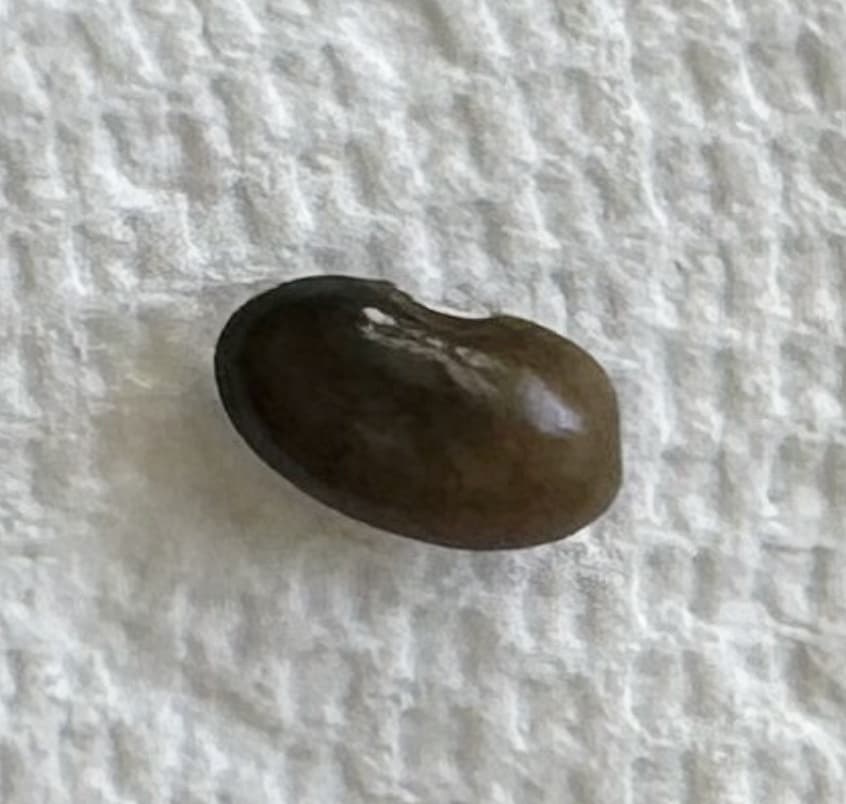
to this?
From a chalky white to a milk chocolate?
Is it a mutation? Was it a recessive bean gene that finally worked its way to the forefront? I have never planted a dark solid colored seed bean like these in my garden. There are no other gardens in my neighborhood. So where did these beans come from?
PS: Colors aren’t my forte!
I hope you enjoyed Ed’s guest post as much as I do. I’m plumb foolish about growing things and I find the whole process fascinating, including the mysteries that sometimes pop up in the garden.
Ed sent me some of the brown seeds and I’m aiming to plant them as soon as warm weather gets here.
Tipper
Subscribe for FREE and get a daily dose of Appalachia in your inbox
I plant a half-runner heirloom variety called Blue Tips. After drying on the vine, picking, and shelling out the pods for seeds to be stored for the following gardening season, I often find some brown seeds. However upon planting the next year I continue to grow Blue Tips. My vines and seeds look very much like the ones shown in the post.
Speaking of beans, as a kid we often had Cranberry beans (we also called them October beans) along with cornbread, sliced onions and buttermilk in our West Virginia home. Nowadays they are hard to find in Cincinnati. One store still carries them and we stock up whenever we go there. Had them just tonight along with sour pickles, cornbread and sweet tea. Always a treat and a reminder of life in West Virginia 75 years ago.
‘Taint no mystery a’tall.
Them Cherokee County beans didn’t take too well to that Burke County soil and rebelled by turnin’ brown.
‘Twouldn’t surprise me none if the brown ones sent back to Tipper didn’t revert to that pristine white in her Cherokee County soil.
Love this story—You did a great job telling it! I enjoy reading anything that is related to gardening.
to ponder while planting my pole beans. Very interesting story, and very well told. I look forward to the 2025 Brown Bean Update!
Great story!❤️❤️❤️❤️❤️❤️❤️❤️❤️❤️
Please let us know what the beans taste like when you get some grown! I am interested, for sure!
Definitely a mystery, I’ve had squash and cucumbers cross. They had a cucumber neck and a squash bottom, tasted like cross of the two.
I’ve also had Cheyenne and bell peppers cross. The bell peppers were too hot to eat.
Mr Ammons can tell a great story with words and pictures. Please let us know the rest of the story as it develops. And to think that one bean did this. That’s a great lesson indeed!
As for Randy’s old tools, I agree that sometimes they are better than the new ones. My old hand sickle can cut weeds when the last string trimmer I bought quit after just a few uses.
nevermind
saw the comments after I posted mine
oops
I found this so interesting when I read this earlier in the morning that I came back to read the comments but there’s nothing yet. Maybe a bug cross pollinated? Also, wonder if the brown beans taste different than the white. Sure hope you talk about it in a video sometime.
Definitely a mystery. I sure want to know how they turn out and if the taste is the same. Thanks, Ed, for the post and the pictures and thanks to Tipper also!
Ed’s bean mystery might have more value than a scientific answer, but my inquiring mind would present the question to the nearest agricultural college for expert commentary…that or to one of the seed companies, but, again, the mystery is as delicious as the beans.
Ed did a fine job with telling us about the beans. I enjoyed both his experience with the beans and the pictures of the beans. I’ve only grown Bush Lake green beans mainly because I don’t have to string that variety. I don’t really grow enough plants to can, but have froze some over the years I planted them since they are excellent producers. I mostly plant them for my mother in-law because she loves cooking up a mess of green beans when they are fresh from the garden. I enjoy green beans too and they are one of my favorite type of beans.
What a fascinating story Ed gave us! Definitely a head scratcher! It would be interesting to follow these changing color beans to see what these brown beans now become! And if there is a different in the taste or texture. As with us humans who might be from mixed ethnicity re: skin tone, that can skip a generation to show up in a later one, perhaps these beans are like that. Is it possible to trace the origins of the white bean, as there might be a clue there?
Tipper, have any of your greasy beans turned like Ed’s? I’ve only saved tomato seeds from year to year. Ed, do they taste the same as the original beans? I’m so curious how this happened. Maybe a rogue bean slipped in somehow? haha
But, who knows the way of nature?
Franne, they haven’t yet 🙂
I don’t even have a guess about how those brown beans came about but I enjoyed Ed’s story very much. Like you, Tipper, I think dried beans are so pretty and those brown ones are more pleasing to my eyes than the white. I would have to do a side by side comparison to see which one my taste buds prefer!
Over my lifetime I’ve eaten soup beans (from dried) far more often than green beans (from fresh.) But I appreciate green beans much more than I did as a child. I look forward to hearing more about Ed’s mysterious brown beans as he and Tipper grow them this year.
Well, I’ll be! My first reaction is that God likes variety and He designed it into His creation. Another related idea is that beans in particular must be among a group of plants that cross easily since there is such a great variety of kinds. Would having that single plant that one year, I wonder, have concentrated pollinators on it especially and introduced new genes? And here is another thing that is amazing. You started with one brown bean but it has – so far – reproduced true and all are brown. Can they – will they – ever produce a white bean again? As a friend of mine says, “That’ll preach.” Or maybe would anyway. Reminds me of Jacob’s lambs. By the way, what are you going to call these brown beans, Mr. Ammons?
They are going to be Tipper Beans if they turn out good. If not I guess I’ll name them after myself.
Enjoyed the story and the comments.
Thanks Ed for the story of one brown bean. I am an avid gardener and will be most interested in the outcome. I suspect that Randy may be right about the original ancestry making its way to the forefront. It’ll be interesting to see if they produce greasy beans. Please do let us know!
Old tools just fit your hands. Like a well worn pair of leather gloves or old work boots. They just belong. It’s like they were just made for you.
That’s a funny tale indeed and the answer my friend is (as I’ve heard all my life) it only takes ONE-just one! Ain’t that something though that perhaps a rattlesnake bean “took up” with a greasy bean and now youve got a unique bean variety-one of a kind, if you will! I grew acorn squash that crossed with baby pumpkins and they were half acorn squash and half orange pumpkin. They’re dandy in my opinion and so I’m taking this moment to THANK my flying pollinator bee friends!! One of a kind I think is very special indeed!
Good story! I enjoy shopping at independent family owned hardware stores too.
Tipper beans!!!!!
I agree! Tipper Beans!
Well I love a good mystery. Anxious to see how The Great Bean Mystery turns out.
Well, let us know how they turn out. I’m curious as to whether they have a different taste from the others. Thanks to Ed for the story and photos.
I am no expert on this, but the only explanation I would have is the bean seeds were originally a hybrid bean and when saving the seed each year they eventually went back to the strongest strain they had been crossed with. My family would grow pole beans (Kentucky Wonders) and plant them in their corn between the stalks. I have my Grandaddy’s old mule pulled Cole planter with two side by side seed hoppers that will drop a corn seed and then a bean seed. It can also be set to plant a single seed.
I watched yesterday’s video of Matt setting his post and heard him talking about old tools and a jig saw. I, along with my son helping me, am also working on a project. I bought number 1 grade lumber at a local independently family owned lumber yard and saved $35 over the price of grade 2 lumber sold at Lowe’s or Home Depot. They also loaded it for me. I bought nails that were still loose and stored in metal bins like in the old days for $2 a pound, the same nails at the box stores that are prepackaged in the boxes sell $8 a pond. I am using a Craftsman miter saw that is 45 years old and a 50 year old blue fiberglass handle Stanley hammer bought for $5 about a month after I married. I like using old things, I guess it makes me feel like I am showing the world that old things and old folks can still “get er done.”
Amen to that, Randy! Just because something is old doesn’t mean it’s obsolete. (actually, it’s better!)
I’m so old that the hammer I bought when first married has a wooden handle. That was long before they started making them out of fiberglass.
Yes, I still use it. And, yes, it has the original handle.