
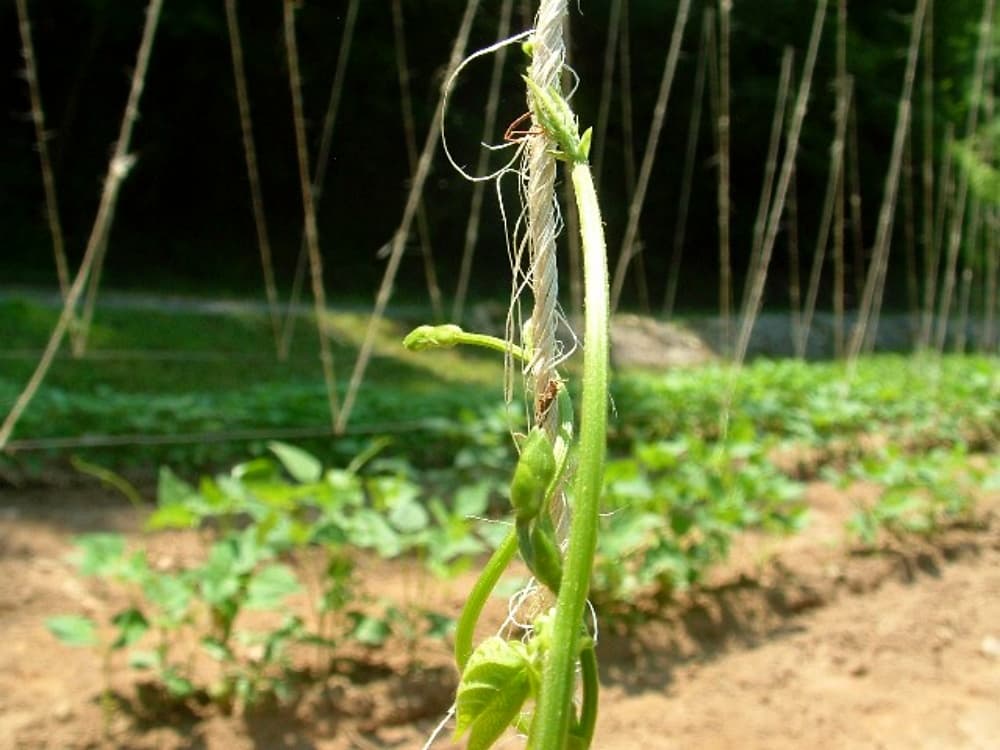
Pap’s growing bean patch
Cornfield bean noun A running green bean planted next to a corn plant so that it will climb the cornstalk as it grows.
1968 DARE = a type of bean that is eaten in the pod before being dried. (Brasstown NC) 1973 GSMNP – 57:84 I’ve knowed the time when we’d have fifteen or twenty bushel of beans, cornfield beans piled up. 1976 Thompson Touching Home 13 = bean that runs up a corn stalk. 1982 Powers and Hannah Cataloochee 199 There was always a pot of cornfield beans with bacon cooking on the stove when the children came in. 1986 Pederson et al. LAGS 11 of 32 (34%) of LAGS speakers using term were from E Tenn. 1995 Montgomery Coll. (Cardwell). 1997 Nelson Country Folklore 118 Cornfield beans had been planted in the cornfield because corn stalks served as a pole for the beans to climb on. In August, the cornfield beans were ready to be picked, and we children helped.
~Dictionary of Smoky Mountain English
Granny dearly loves cornfield beans but she plants them on a trellis. In other words for her a cornfield bean is more about the variety than actually growing them in the corn. She likes them because they make a big ole bean. The seed she uses came from farmer Tim down the road. His seed has been handed down in his family for generations.
Pap never did plant beans in his corn, but Granny snuck and did a few times 🙂 She loves green beans so much that she would plant them anywhere she found an open spot. They always grew white half runners and she didn’t even care if they run across the ground in places. She’d just bend over and pick them.
Folks ask us every year if we plant beans in our corn. This year we thought about trying it in at least one row.
Back when Granny planted beans in Pap’s corn it made a real mess. Might have been because the corn was sweet corn and not sturdy enough to hold up the weight of the beans or might be she planted too many beans 🙂
I’ve heard about the three sisters planting method used by the Cherokee all my life, but we have never attempted it either.
If you’re familiar with cornfield beans do you think of them like Granny does as a variety or a description of any bean that is grown in the corn patch?
Last night’s video: The Family History and Stories of Opal Corn Myers 22.
Tipper
Subscribe for FREE and get a daily dose of Appalachia in your inbox

I’ve never heard them called cornfield beans only the three sisters. We don’t have a big enough garden for corn yet so I’ve never had to chance to try it! We planted scarlet runners for the first time this year and they’re looking so good! Beautiful, bright red flowers and just reaching for the sky! Looking forward to a good mess from them!
Hi Tipper, do you have any idea where I could find cornfield bean seeds. We always had seed beans when I was growing up and even into adulthood, but those were lost and I can’t find them anywhere. I’m from Waynesville originally but live in GA now and no one here has even heard of them. Thank you for your help!
Tipper–“Creature” corn (for feeding chickens and hogs) or milling corn (for cornmeal) are ideal partners for climbing legumes. Two excellent old-time choices are Hickory King and Hickory Cane. I used the word legumes advisedly because many kinds of crowder peas (or hulling beans, clay peas, zip peas, or whatever you want to call them) will climb with a will given the opportunity. You now have, if you haven’t “let the seed run out” an ideal climbing bean in the Nantahala Runner Beans our dear departed friend Ken Roper grew. I know Br’er Don gave them the best opportunity to reach Heavenward he could with some long cane poles, and they were still going strong when the ran out the top (and out of his reach from the highest up he could climb on a step ladder).
Grandpa Joe regularly planted climbing beans with his corn, and while field corn (his term) went from sugar to starch stage quite rapidly, it made delicious roasting ears for a short time. Successive plantings translated to corn on the cob on Grandma Minnie’s table through much of the summer.
So glad you brought this up Tipper. I also want to know the when, where, how and what of “cornfield” beans. Seems pretty clear we have mostly lost the “secret” of it. Melanie’s fall and dry crop idea sounds for sure like one of the “keys” to it working. Related to that is that weak corn stalks (modern hybrids) just won’t work. As Melanie noted, that makes for a tangled mess. That’s what I got when I tried it.) I think summer green beans (versus fall shelley dry beans) would need to be of bean varieties with short runners (under 8 feet, 6 feet probably best) and with some shade tolerance (unless corn planted wider?). All said and done, to work it needs a good (very good?) balance of factors – as usual. And modern seed selling will not tell us, most likely, some things we would need to know; length of runners, shade tolerance, strength & typical height of corn, etc. I think all that says, find somebody who does it and get them to tell you how and/or share hand-me-down (heirloom) seed. I have posted this before but the Choctaw Cultural Center at Sulfur, OK demonstrates the 3 Sisters planting and their corn is 12-15 feet tall so sturdy is not an issue.
My Mama planted peas with the corn. They are very small peas she called her Fall peas as they are not ready until Fall of the year. The corn was field corn with sturdy stalks. The peas are picked as soon as they fill out and cooked fresh not dried. She did save some to dry out for seed each year. I have them and plant them on a bamboo teepee. She gave me seeds years ago and I have shared with people who have shared them. Mama would have liked that. I try to save some seeds each year too.
I have tired the three sisters method a couple times back when I planted corn. Every time the weight of the vines would pull over the corn when we got any kind of wind or a lot of rain. But I’m not the best gardener.
My Cherokee relatives all planted the Three Sisters together: corn, beans and squash. They knew that the 3 were companions in the garden. It turns out that the beans fix nitrogen in the soil that feeds corn which is important because corn is a heavy feeder, needing a lot of that nitrogen. Both the beans and the squash would climb up the corn stalks too. It took up less space to grow good veg for the family.
We had sweet corn in the garden and bush beans planted separately. We had field corn in the cornfield and planted cornfield beans in with it, but not at the same time, if I remember correctly. The corn was up and well established before the beans and punkins seeds went in the ground. I remember carrying a pocket full of corn seed to replant it while I was planting beans. Punkins weren’t planted regularly. I don’t remember the spacing but I know they weren’t between every hill of corn and not in every row.
The corn was called field corn. It was used as animal feed (tops and fodder) as well as ground into cornmeal for people food. The name I remember is Holcomb’s Prolific. It grew tall and sturdy with two or three big ears per stalk. It was planted in hills of two or three seeds spaced about 18-24 inches apart.
I am sorry, I can’t remember the name of the beans but they were a cornfield variety, adapted to growing in conjunction with field corn and punkins and were mainly eaten as a dry bean but could also be eaten as a fresh snapbean in their immature stage. I can’t tell you anything about the flavor or texture because I refused to eat them. Had I been more interested I might have brought that knowledge with me.
I’m with Louzene! Cornfield beans is a variety, perhaps more than one. I never knew or don’t recall the name(s).
Sometimes we planted peas instead of beans. I wouldn’t eat peas so I can’t recall their name either. It’s like people, I guess. If you like them you easily remember their names.
I have planted beans in my corn rows, not because of a lack of space, but because that was what my parents did. Mom waited until the corn was a few inches tall before she planted the White Half Runner beans beside the stalks. The few years I planted corn and beans together, they both ended up on the ground. I’m not sure if the coons broke my corn stalks or if the beans did. Nowadays, I rig up six bean trellises by using a PVC pipe to hold a lightweight bicycle rim that is secured with nuts and bolts about 6′ high. You’d be surprised how many green beans you can plant under the circle. Tie some twine or string randomly around the bike spokes and run it to the ground. Then tie the string to plastic forks and push them into the dirt to keep the twine in place until the beans start running. Easy pickin’!
When my dad returned from WW2, I was 3 years old. He cleared land that had overgrown during that 3-4 years he was gone and planted crops. He gave my older cousin a sack of corn with instructions on how far apart to drop the kernels. He then gave me bean seeds and said, “Get behind Elden and every time he drops a corn seed you drop a bean.” Elden was about three rows ahead of me when dad started yelling. I was watching Elden and dropping beans every TIME he dropped corn. Dad wanted beans dropped every PLACE there was a corn seed. I spent quite a bit of time gathering beans where there were piles of them. I dropped one every TIME Elden dropped corn. He had a stride about four times as long as mine. Some of the time I probably stood still watching Elden way out at the other end of the field to see when he dropped another kernel of corn. Adult’s instructions aren’t always clear to children.
Throwback to the Three Sisters method (corn, beans, squash). Very smart!
The 3 sisters method sounds like it would be an efficient method especially if you had limited space for a garden. As always enjoyed last night’s reading.
I had never heard of the Three Sister planting method which was developed by the Native Americans until recently. I was watching Ms. Lori’s channel (Whippoowill Holler) recently & she talked about it.
The Corn is the trellis for the beans (or peas) and the squash is the soil cover to keep the moisture & nutrients in the soil. I hope Granny’s “Two Sister” planting does well this year.
This year I’ve planted a couple of pole bean seeds next to every sunflower coming up. Last year’s stalks were so sturdy they should have no trouble holding up the beans which fell over last year on my self made trellis. I agree with the people saying it probably depends on the variety of each whether or not it will work today.
(Don’t have room for corn but if I did the raccoon that drinks out of the bird bath would be very happy with me.)
When we made our first garden, 3 years ago, I was eager to try Three Sisters planting. I researched it online and watched videos and planned it all out. Stuart made enough room in the “in-ground” part (as opposed to our raised beds) for me to do 3 mounds. We also planted 4 short rows of corn – just 1 of the sisters. It didn’t work well for a few reasons. I chose Peaches and Cream corn- not very tall or strong, and it didn’t get enough hours of sun where we put it.
I planted Kentucky Wonder beans and, boy! Did they climb those corn stalks! We had also made a teepee structure out of canes for more beans and the 3 Sisters beans reached out to their too-close neighbors on the teepee and they all grew in a tangled mess. I planted yellow summer squash at the base of the 3 Sisters because I don’t really like winter squash and I thought the big squash leaves would fulfill their role in the scheme just fine.
I think the main reason it didn’t work as I expected it to was because that method was historically used for crops that weren’t picked in the summer. The corn wasn’t sweet, fresh corn like we grow to eat at the height of summer. It was dried and cut off the cob and used in Fall and Winter. The beans weren’t eaten as fresh green beans, but allowed to dry, then hulled and cooked later as soups. And they were growing hard winter pumpkins, not soft tender summer squash. Everything was probably harvested about the same time. The way we did it, it was hard to pick corn without breaking bean vines and the beans grew in a big tangled mess. I don’t think we even got 1 squash- something ate the plants. The corn made ears and even tasseled but we had a couple bad storms that broke a lot of it over & never got a single ear that was even half full. We got a fair bit of beans, though but we learned not to make our teepees so tall next time. I’m glad we tried it, but it was a fail for us.
My Granddaddy and other neighbors would plant cornfield/running beans in their field/mule corn. Their favorite variety was the Kentucky Wonder. I have my paternal Granddaddy’s mule drawn Cole planter, it has two side by side seed hoppers that will allow you to plant two different type of seed at the same time. It will drop a corn seed, then a bean seed between another corn seed. It has a selector that will allow you to plant one hopper at a time or the two hopper method. I have not seen many of these particular type of Cole planters. I don’t think many people do this now because of planting today’s shorter smaller stalk sweet corn such as silver queen or my area favorite merit corn which is no longer available. I once tried the 3 sisters but because of the hot dry weather it was not successful.
I rarely saw planters like that when I was growing up. Our property didn’t have enough flat land to even make it an option. When your rows are shorter than the mule and planter combination, you are shooting yourself in the foot. We and our neighbors were lucky to have fields that were an acre in size.
There were a few folks down along the river that had fields large enough to justify a planter like you describe. Their land was flat and very rich. Ideal for growing many crops. But, about every third year spring floods would wash it all away or cover it all with mud and silt. It was a tough life mountain farmers had with challenges that most farmers weren’t even aware of.
Ed these planters were multi purpose, what I mean by that is there were different seed plates that could be changed to plant different seed. They were were most often used to plant many acres of cotton and field corn. Other than planting field corn, they were not used very much for planting a garden. Some Cole manufactured planters had one seed hopper and another hopper for fertilizer. This planter did not have fertilizer hopper. A separate guano distributor also made by the Cole company was used for putting out the fertilizer when planting cotton or corn. These planters could be used anywhere you could plow a field with a mule and plow.
We will be planting some brown stick beans in our corn. My husband’s grandmother always did this and we do it from time to time. This is the year for it as we need to save seed from the brown stick bean. She always planted her kushaw in the corn as well, but I’ve never had much luck with that.
My mamaw died when I was only 22 years old so I learned so much from my husband’s grandmother. She and her sisters did everything the old ways and had such wonderful knowledge that I gleaned from. I wrote down all the things they told me, from hominy to sweet potatoes, so my children would have it too …even how to clean a hogs head and make souse meat. I’ve still yet to do that…LOL
The brown stick beans came to them from the Tennessee mountains in the 40s when my husband’s grandfather preached in the small churches there. We don’t really know much other than that about the beans. They are flat like and the bigger the bean gets the stringier they get, but they have such a wonderful flavor. I leave them sometimes to get the big beans just to hull and cook with a piece of salt meat. So good.
I can hardly wait to see the comments on this. I love to hear other’s ways on things.
Thank you for your consistent and encouraging content, Tipper.