
Today’s post was written by Paul.
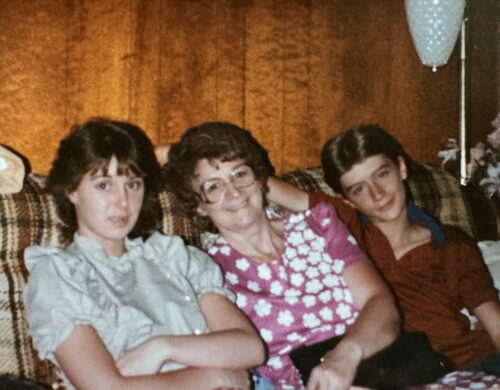
Tipper, Granny, Paul
When Tipper still lived at our parents’ house, she had a CD of old time music published by the Smithsonian. I think she purchased it through her Columbia House membership. I asked if she still had it, but she was unable to find it.
Some of the music on it was crude in terms of recording quality and execution (because it was so old), but there were several tunes that we loved.
From that CD, I learned “I Hate that Passenger Train,” which I featured in 2019 as part of our Train Song Series, with Katie on fiddle (see video here).
I don’t remember who was doing “Hate That Passenger Train” on that CD, but it was maybe from the 20’s. Years later, Doc Watson popularized it, and today, folks like Billy Strings perform it.
Interestingly, the CD featured both the song I’m sharing today, “Cora is Gone” and the song “Darling Corey.” I can’t remember who sang either of those songs on the Smithsonian collection.
These two songs are often confused with each other for good reason! “Darling Corey” is quite old, while “Cora is Gone” was written by Mac Odell in 1950. According to Wikipedia, the words in “Darling Corey” first appeared in the song “The Gambling Man” and was “collected” by Cecil Sharp in NC in 1918. It seems more of a murder ballad. It has lines like “the highway robbers are comin’, gonna tear your playhouse down,” and the chorus repeats “dig a hole in the meadow,” ending with “gonna lay darling Corey down.”
Some years after Tipper and I listened to that collection, I came across Flatt & Scruggs doing “Cora is Gone.” I found it interesting that Lester sang “Corey,” though the title read “Cora.” The same was true of the recording on the Smithsonian CD. There are quite a few covers of “Cora is Gone” on YouTube. I sampled 4 of them, and they all pronounced the name as “Corey,” while stating the title as “Cora.” I began to theorize why this might be.
I first thought of a phenomenon where singers modify vowel sounds in order to make it easier to hit high notes (see this Wings of Pegasus video for explanation); however, when I sang the song, it was just as easy for me to sing “Cora” as it was to sing “Corey,” and none of the versions that I’ve heard seem to be in a key high enough to challenge the singers’ range.
Some vowel substitution was indeed going on in the Smithsonian recording of the other song, “Darling Corey.”
When we listened to the CD, I was confused by the chorus of that song because it sounded like the singer sang “middle” instead of “meadow.” I asked Tipper, “Bury Corey in the middle of what?” She just shrugged.
That word fell at the highest point of the chorus, and instead of singing “med” “o,” he sang something like “mid” “il” as he ascended to those notes. We were listening to the CD back before the internet, and there was no way to decipher that word from the song title. When I later heard other groups sing the song, I understood the word to be “meadow.” Anyway, back to the mystery of “Cora” vs. “Corey.”
In “Darling Corey,” it’s always sung as “Corey” and usually listed the same in the title, though occasionally listed as “Cora.” In “Cora is Gone,” it’s always listed as “Cora” yet always sung as “Corey.” Since I ruled out the vocal technique of vowel modification as an explanation, I next wondered if Lester Flatt simply sang the lyrics incorrectly, and since F&S have the most well-known recording, everyone else followed suit (even though the title reads as “Cora”).
I have known subsequent performers to be so enamored with performances that came before them, that they will even mimic mistakes in pitch, timing, and/or lyrics in order to sound like “the original.”
After digging further through resources online, it appears that the first commercial recording of “Darling Corey” in 1927 used “Cori” or “Corey,” though that recording was never released. Two more recordings followed that same year, and they used “Cora,” at least in the title.
Afterward, most recordings featured “Corey,” but somewhere along the line, the name Cora returned, at least in the title (perhaps when published in a sheet music collection of folk songs), even though singers continued to sing “Corey.”
One would have to ask Mac Odell to know his intended pronunciation of the name, but I wonder if Lester may have sung the name as “Corey” instead of “Cora” in “Cora is Gone” because he heard some of the earliest versions of “Darling Corey” (perhaps along with the source song “The Gambling Man”) when he was young.
It’s all very confusing with regard to both songs! Do some folks read/pronounce both names the same? If so, why? I like both names but chose to sing “Corey” while writing it as “Cora” in the title, just to continue the dual-name tradition.
Maybe in a future old timey Tuesday, I might attempt “Darling Corey.” In the meantime, it’s easy to find covers of both songs on YouTube.
Paul
What a great song! I really enjoyed Paul’s singing and his picking. I was also fascinated with his discussion about Cora verses Corey.
Matt had a great aunt Cora who they called Corie. That’s who our Corie is named after. Changing the end of names to an ie, y, or er is very common in the mountains of Appalachia. Sarah often becomes Sarie, Ina becomes Iner, and there are many other similar name changes.
I’m guessing that attribute of Appalachian language is responsible for the name change from Cora to Corey that Paul mentioned. If you’d like to know more about names in Appalachia here’s a video I did a few years back.
Hope you enjoyed Paul’s version of “Cora is Gone” as much as I do.
Tipper
Original singles released on Spotify.

Hi, Paul. I assume you’re aware of the 1927 Bristol Sessions (the “Big Bang of Country Music”) resulting in Bristol TN being designated “The Birthplace of Country Music”. During those sessions, B. F. Shelton was recorded singing “Darling Cora”. I grew up in Bristol and knew my Aunt Cora only as Aunt Corey. Interestingly, one of my mom’s friends was named – and called- Cora, apparently by her preference.
Loved the song!
Tipper–I’ve got a question that maybe you can answer, but if not, Paul certainly can. That’s a lovely looking autoharp hanging on the wall behind him in what I assume is his home music room/studio. I’m curious about the other instrument, which could be a homemade banjo using either a gourd and/or groundhog skin. Is that the case or is it a professionally made instrument?
How interesting! My grandmother in law was Dora but called Dorie. They were from Indiana. My youngest daughter is named for her. We call her Dorie. I just love names, words, and dialects! ❤️
I wonder id any of these are the CD https://folkways.si.edu/search?query=Darling+Corey
https://www.youtube.com/watch?v=1yHk1PeSvOo
That famous 1937 ballad “Hang Down Your Head, Tom Dooley” was based on the story of a real man named Thomas Dula. In the local dialect of Pick Britches Valley in Watauga County, NC, Dula was pronounced Dooley, Pauline became Perline and Paula became Polly. So, I am sure Cora was pronounced Corey. Here’s the reference: https://www.loc.gov/static/programs/national-recording-preservation-board/documents/TomDooley-FrankP.pdf I must say that I love the name Pick Britches Valley!
Tom Dulla was captured in Doe Creek near my parents home in Pandora, TN (Johnson County).
In North Georgia, an A on the end of a name would not be pronounced, and to do so would be considered to be “ trying to talk proper,” or putting on airs. You would think even the die hard mountain folk couldn’t do anything with , Brenda, my name. But, you wouldn’t be wrong. I became Brender.
Lol
Paul, I LOVED the video! Loved your southern voice, fantastic guitar playing, the words of the song, the lilt of the music, watching your fingers fly, the emotion you put out….it was all just fantastic! Thanks for the entertainment!!! May God bless and keep you and your family and all your fans!
I heard this a few days ago on the BP&A channel and Paul, it was wonderful! You did a great job picking and singing. Thanks for sharing. Have a blessed Sunday!
This may be another example of the written “A” pronounced “E”. A well-known example on this site would be “okrA” that gets pronounced “okrEE,” which is how my Mississippi gra”ndmother pronounced it, too. And then, there’s the “Grand Ole Opry”!
Once I visited some people in Metter, Georgia, and asked about the origin of the town’s name. This may be apocryphal, but it’s what they told me. When the community decided to become an official town, they sent a representative to Atlanta to register it properly. They wanted to name the town after a prominent feature (?), its *meadow*. So the *feller* went to Atlanta and promptly registered the town Metter.
Maybe they were just having fun with this outsider, but that’s what they told me.
always love these old songs. And yes Corie is how we’d pronounce it. Thankyou Paul!
i was just coming here to say that, tipper says okree instead of ocra. i’ve only heard ocra all my life (and i heard ocra a lot because my mother absolutely hated it and never tired of saying so. understandably, i have never knowingly tasted that nasty, slimy, ocra!)
The “okra” slime is there to hold the cornmeal on in the frying pan. Saves making up a batter and wasting most of it. Have you ever thought of frying it?
My mother’s first name was Cora. She had a siser named Dora. Their names were pronounced as spelled. On the other hand, my parents both called okra o-kree, with the accent on the “o”. My Irish paternal grandmother was an Okelley, written solid, (no apostrophe) and pronounced with the accent on the “O”. (Other Irishmen commonly spelled their name O’Kelly and stressed the second syllable.) Several Okelleys are buried in Westminster, SC, including my great-grandpa, William Pinckney Okelley, whose big Waltham pocket watch I inherited from my dad.
this makes me think of my tampa mother’s generation, too (stretches almost the entire 20th century): idea was EYE-dea, sarah was SAY- rah, ETC.
for the most part they were aware of the differences and, for the most part, either ignored them or emphasized them sarcastically. apocryphal story of my reconstruction-born grandfather: asked in school to make a sentence illustrating the words depot and delight he said “put dee pot on dee table and turn out dee light.” sometimes, though, it backfired: my mother left the south before wwii and, when somebody actually corrected her joking pronunciation yacht as “yatchit”, thought she’d better stop or people might start believing her a moron! (MOE-ron.)
Where I come from Sarah was Sir-uh, Cora was Corie and Cory was a boy.
I’m inclined to think the switch from Cora to Corie is a regional and deliberate change. Somebody doing print thought it ought to be “Cora” and the folks singing knew better. I can’t think offhand of other examples but I expect there are some. If that is the case, it would be in spite of knowing it is spelled differently and ought to be pronounced differently but just going with what they knew was “right”. There is a stream in Scott County Tennessee with the name on topographic maps given as “Difficulty Creek”. Locals pronounce it as “Dee fick cul tee”. As to who knows “best”, I reckon the answer is, ” It depends.” Grin
Always enjoy Paul’s picking and singing. That is a great old song too. I find these discussions on language and the different pronunciations of certain words interesting.
Happy Sunday! I think I can answer your questions regarding the pronunciations.
My people are from eastern Kentucky, the same region where many of the country and bluegrass greats came from. Kentucky sure has given us some of the greats, such as Bill Monroe, the “Father of Bluegrass,” and Loretta Lynn, the Coal Miner’s Daughter. Ricky Skaggs is actually my third cousin and comes from Eastern Kentucky.
One thing I’ve noticed is that in this region, anytime there’s an “a” vowel at the end of a word—especially in names—it often gets pronounced like a long “e” sound. I could give you countless examples. For instance, my grandmother’s name was spelled Tera, but no one called her that! Everyone said Terri. My great-grandmother was Cora, but nobody ever called her that; she was always Corey. My mamaw’s sister was Ella, but… you guessed it, she was Ellie!
Because of this, I believe the “Cora” vs. “Corey” variation in these songs isn’t just a matter of mishearing or vowel substitution for singing—it’s a regional dialect influence. In eastern Kentucky (and surrounding Appalachia), it’s very natural that Cora would be pronounced Corey. That local speech pattern likely carried into the way the songs were sung, recorded, and passed down, which might explain why we see the title one way but hear it another.
I think Tipper might find this especially interesting since she studies language in Appalachia. I certainly have always wondered at this!
Have a blessed Sunday!
I’d agree that it’s probably simple correct spelling of a name vs common pronunciation. Two examples out of my family involved two great aunts. Ida was pronounced Ider and Corene was pronounced Kneer.
Happy Sunday! What interesting information on the song title, singers that song it and how the pronunciation was changed even though no one actually knows why. I heard Paul sing it the other day on the BPAA YouTube channel. I enjoyed the tune and him singing it.
As a history major from UNH I love posts like this. How people pronounce words or change them according to where you live. The small town I grew up in was blessed with different ethnic communities: French, Irish, and Greek. So talking to someone in my town meant you would hear a person speaking English and every once in a while throw in a French or Greek word.. My parents came from French parents where only French was spoken. When my brother and I were ready to enter First grade at the French Catholic school in town we could get in because we were part of the “baby boom” of WWII so that’s when my father made the decision that only English would be spoken in our house. At large family gatherings in Maine, where most of my aunts and uncles lived, my Dad would yell out from time to time English please. Working in management for a grocery chain I would visit some stores in NH where mostly French was spoken. Language can define a region and keep people apart which is sad. What your posts do is explain the language so we can be as one and understand each other. Again great post. Have a blessed day.
Ron, I am writing this to be humorous. I worked on blue collar jobs during the 38 years I worked for Michelin. When I started working there on Feb. 2,1976 many of the machines were still being installed by both Frenchmen and American mechanics. It would tickle us to hear the Frenchmen talking in French and all of a sudden start speaking English cuss words when they ran into a problem.