
When I was a sophomore in high school Gearldine Meadows was my biology teacher. Our big project for the year, other than dissecting frogs (yuk!) was to collect leaves from trees and document them in a notebook along with their corresponding scientific information.
Pap helped me gather the leaves. We stogged all over the ridge above the house.
Seems like Mrs. Meadows wanted us to have a certain number of specimens. I don’t recall the exact details but I do remember I got an A.
Mrs. Meadows was a great teacher. She liked me enough that I became her class assistant in my junior year.
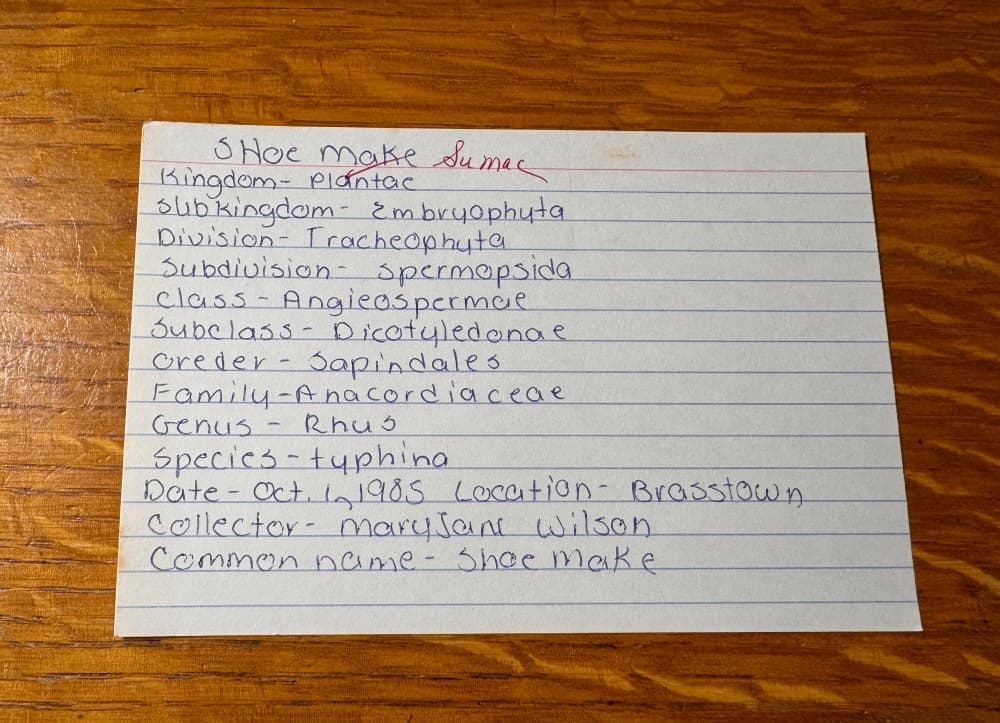
One day when I was cleaning out at Granny’s I found my notecards from the project. I wish I knew what happened to the book of leaves but I haven’t found it so far.
As I flipped through the cards the one above gave me the biggest smile 🙂
I showed it to the girls and said “See my Appalachian was showing.”
Shumake noun The sumac bush (Rhus glabra). Its bark is made into a preparation to treat burns, and its blossoms and fruit are used for a tea drunk as medicine or for refreshment and called sumacade.
….1927 Thornborough Tramping 466 He also told me that the mountain people call hemlock “spruce pine,” the black spruce “he-balsam,” the Fraser balsam “she-balsam,” the sumac “shumake,” the butternut “white walnut,” while cucumber is humorously called “cowcucumber.” 1936 LAMASAS (Madison Co NC, Swain Co NC). 1966-68 DARE = causes itching and swelling (Brasstown NC, Burnsville NC, Cherokee NC, Spruce Pine NC). [1971 Krochmal et al. Medicinal Plants Appal 214 The dried ripe fruit of sumac is valuable as a source of tannic acid. Preparations of these fruits are effective as astringents, anti-diuretics, and tonics. In Appalachia, leaves are smoked to treat asthma.]
—Dictionary of Smoky Mountain English
Last night’s video: We Had the BEST Dinner || Bacon Crusted Cornbread in Appalachia.
Tipper
Subscribe for FREE and get a daily dose of Appalachia in your inbox
