
When I mentioned pulp wood cutters in yesterday’s post, Ed Ammons pointed out that everyone might not know the definition of a pulp wood cutter.
Pulp wood is used primarily to make paper. Loggers who cut pulp wood in my area, like my Papaw, took the wood to a local woodyard where they were paid for it. The woodyard in turn processed the logs and sent them on to the mill in Canton NC to be made into paper.
In 2023 the mill in Canton closed. My first thought was one of sadness for the loss of jobs for folks who worked there. They were good jobs for our area and I knew they couldn’t be easily replaced.
My second thought was for all the pulp wood cutters and related industries in all of Western North Carolina. If there’s no mill there’s no need for pulp wood.
The closing of the mill in Canton was a hard hit for the whole economy of Western NC.
When my Papaw was coming up there wasn’t many options for employment. Everyone farmed to feed their family, but only folks who had large parcels of land could farm for profit and that certainly wasn’t him.
When Papaw first started out in the logging business he used a cross-cut saw.
Once those new fangled contraptions called chainsaws made their way into the mountains everyone could see the ease and speed at which you could cut wood with them. But the new power saws were out of Papaw’s budget.
Papaw and Virgil Dockey had been cutting wood with a cross cut saw together. As they studied and figured on the issue at hand, whether to buy a chainsaw or not, they came to the conclusion that buying one would not only make their livelihood easier it would allow them to make a bigger profit as well. In the end, the two decided they’d split the cost and buy a chainsaw.
Pap said talk of the power saw and what it meant kept both families at a heightened state of excitement especially the wives.
Finally the day of the big purchase arrived. Papaw and Virgil pledged $200 for the saw at the old Smith Store and then brought it home to show the children and wives. Virgil took it home with him and put it on the front porch in anticipation of all the work that would be accomplished on the coming day.
During the night a thunderstorm blew up and as bad luck would have it lighting struck the chainsaw and blew it up.
The following day Virgil came into Papaw’s yard hanging his head saying “we’re ruin’t we’re ruin’t.”
Pap said you never saw such a sad bunch of folks even the children recognized the devastation of loosing the chainsaw that was bought on time knowing payment would still be required even though Mother Nature had played a cruel trick on them.
After much hand wringing Papaw and Virgil decided there was only one thing left to do, take the saw back and see if they could at least sell it back to Smiths for parts.
Oh happy day! When they arrived at the store they discovered they had unknowingly bought insurance along with the credit plan. They picked up a new saw and headed for home.
Pap said the families rejoiced and everyone made sure the power saw was never left outside at night again.
Papaw Wade has been gone for over 30 years, yet every time I smell sawdust I feel like if I turn around fast enough I’ll see him standing there in his overalls with his hat brim turned straight up and his eyes twinkling.
Last night’s video: March in the Appalachian Mountains.
Tipper
Subscribe for FREE and get a daily dose of Appalachia in your inbox

Dorie Woman Of The Mountain. Probably one of the best books I have ever read. I read it to my husband and he couldn’t wait for the next reading putting the remote down. I ended up buying the book. Lucky’s grandfather was killed in the logging camp at age 27 years old. He had a friend that worked at the Wonderland Motel. His grandmother was a midwife (Granny Women), herbal doctor and wrong and sang “Old Harp Songs”, Dr John Ogle was one of my ancestors. My moma worked for him. I have a different side of him. So many stories in the book sound familiar to the times. Thank you Tipper for the information on this book. Be bless
Mine is a sad story. My first cousin by marriage once removed was a logger. He was killed when a load of logs rolled down on him. He left a widow and three children.
I just love this story. The sawdust scent connection between you and your Pap really pulls at my heart. I can still remember how my Daddy smelled when I was little.
Two comments, Gene you have heard me talk of Danny in our offline emails to one another. I helped him cut the 5 ft sticks of pulpwood for a little while. He had extended the frame of his old pulpwood truck to be able to haul more wood, before putting a dead axle under the extension, the fully loaded truck (4 cords) would do a wheel stand (front tires leave the ground) when shifting from granny gear to second gear. Brenda, in my area, sweet gum was also cut in 5ft lengths just like pine pulpwood. It paid about $10 less per a cord. I think it was used to make OSB board that is so popular now. I know of a fine Pentacostal lady getting her letters turned around at Lowe’s when asking for some of this wood, she will never live it down. I suspect many carpenters had called it by the same name.
Beautiful story!❤️
Some of the old pulp-wood trucks I remember got banged up pretty bad and were not well maintained. Somewhere I have a picture of a set of dual wheels on the side of the road. I’m almost certain they separated because of a broken axle on a “short-wood” hauler. The truck that lost them had been hauled away when I got there. After that, I always left plenty of distance when I was behind a pulpwooder, which was often in North Florida in the the ‘sixties. There were paper mills in Pensacola, Panama City, Perry, and Palatka. The forest-products industry also included collecting pine resin for turpentine distilleries, and long train loads of pine stumps were still a common sight. I never learned their destination or anything about their market value or uses, but surely the “stumpage” business was quite profitable.
Great memories you have to share and thank you for explaining what pulp wood was because I honestly didn’t know.
There is a pulpwood company that’s located over 50 miles away but they don’t make paper. They make the kind of plywood that is ground wood that’s glued together. I call it pressed wood, but I don’t know the actual name. There is also a plant about 20 miles away that uses poplar logs to make actual plywood sheets. There is a great deal of logging going on in our area of Appalachia. Hubby buys a big load of logs each year for our firewood. He’s been using a chainsaw since he was a teenager. He loves cutting and splitting firewood. His grandfather had him cutting smaller stuff once when he was about 17. The saw slipped and he cut into his left calf. His grandpa hauled him in the tractor wagon to his house where his dad was. Fortunately, in addition to being a coal mining foreman, his dad was a trained EMT—and he wrapped it quickly and rushed him to the ER. They had to clip lots of tissue and muscles that had been destroyed so they could sew muscles back together—180 stitches later, he was told he would wear a high sole shoe on that side for the rest of his life. He didn’t give up. He went turkey hunting. His grandpa dropped him off down the road and as he hobbled through the woods to find a place to sit, he stepped down and stretched those calf muscles back out. He said it felt like his leg ripped inside, but he was determined not to wear a higher sole and he never had to. He has cut lots of trees and firewood over the years since. That long scar is a gentle reminder to always be careful and to never give up.
Tipper, that was a wonderful story that indeed had a happy ending. I remember when the mill in Canton closed and how sorry we were to hear about it. When jobs are lost, it just ruins families and communities. I remember having a friend who has since passed talk about driving those big logging trucks and if the logs were not loaded well, and you had to make a turn those logs would shift, and it was very dangerous. Western North Carolina needs our prayers for sure. We are in Johnston County, NC and we could smell the smoke of the wildfires Sunday. So sad but we keep praying and will continue to each day. There are also many other areas that need our prayers too.
Cutting pulpwood is a hard business and physically demanding. I never did it, but
my father had a pulpwood crew in the flatlands of eastern North Carolina back when I was
a boy in the 1950s. They would cut the trees up into logs, load them on trucks, and take them
to the railroad, where they would be shipped to Franklin, Virginia and made into
paper. I’ve never forgotten one of the trucks stopped on the roadside in front of our
house. One of the men was in great pain and he died not long afterward. Later learned
that he had had a heart attack. He had some grey hair and was probably too old to be
doing that king of work, but good jobs were hard to find back then. His name was Walter
Wolfe. My brothers and I got to know all of the crew members by name. Daddy was only
in that business for a few years because it got to the point where people would no longer
sell their timber or maybe just didn’t have it to sell in sufficient quantity. Even when
business was good, he had to scour the surrounding counties looking for timber to buy.
Fortunately, Daddy was a real “go getter” who grew up during the Depression. Even though
Mama said her father told her just before she married Daddy that she would “perish to death,”
we never went hungry. Before he married her, he had promised Mama, “we’re gonna eat if we don’t
do nothin’ else.” Kept his word.
Thank you for explaining that. I like the story too, I remember reading about that before but had forgotten, and glad that it had a happy ending. I love that last sentence in your post and love what Susan wrote. I completely agree!
Another sweet memory read Tipper. My Daddy, in his young, just starting out years, so was what we called a ‘logger’ and he started out using a crosscut saw for many years, eventually using the chain saw when it came into being. Much of what was fell/cut was used for lumber because of the huge size of the trees, with the smaller ‘around’ trees used for pulp. Logging trucks are still seen today on many roads and highways – so I loved the photo. I can still recall that pulp mill smell!! Whooeee!
I have wrote way too much, but I want to say, I have the upmost respect for the men of the past that were willing to work jobs like pulpwood, logging or other very hard labor jobs to make a “poor man’s dollar” to raise and making a living for their family. Unlike the generations of today, they had to much pride, self respect or whatever else you might want to call it to ask, beg or expect the government or other places for money or hand outs.
For the ones that have never heard this, look up Jerry Clower’s story “Marcell and the beer joint” on You Tube. It is about Marcell, pulpwood, and a beer joint.
Loading pulp wood (we called it “bugwood”) and baled hay are very similar jobs. From the ground, you have to pick up and ‘toss’ those 5 foot ‘sticks’ up to the top of the ‘rick’ layed cross ways on the truck bed. All the “bugwood” I knew was southern yellow pine thus coated on every cut or peeled surface with pine ‘roisin’ (pronounced “raws in”). Your hands, arms and thighs got coated in it. On the way home, Dad would sometimes stop by the store for a dab of essentials; milk, bread, eggs. There were girl classmates of mine at the checkout and I would just hope and hope he wouldn’t stop because he would give me the money and send me in. They looked so cool and fresh and pretty in their nice, clean clothes. One of them once told me at the end of a woods work day (thankfully NOT at the store), “You look like an old man.” Felt like it to I expect judging by the way I feel now. As I mentioned here on BPA in the story of my father-in-law; “bugwooding” in our country was hand-to-mouth, “getting by” to try and fill the chinks if that was all you had, something to ‘tide you over’ until something better. But I’m glad I grew up working. And I did marry a local girl, just not one from the checkout line. I still get awful grubby and really am an old man. But she has stuck with me.
We have a paper mill in West Point, Virginia. It’s been there for a long time. When we used to go to our camper in Deltaville, we’d see logging trucks headed in the opposite direction, so we knew they were going to the mill. You knew you were approaching the mill by the smell from it. It’s a huge operation and a major source of employment in this rural area.
The last time I visited North Carolina my family and I took a trip up to Cherokee. At one point we began to smell an unpleasant oder. My mom said we must be near Canton. After reading this morning’s post and comments, I imagine the folks in that area would welcome that scent of their “bread and butter ” once again. Hoping and praying for better days for Western North Carolina.
I grew up in Sevier County and it wad always breakfast, dinner and supper. It still is, but sure has has been confussion over the years to my son and his family. Even now he will say “now you mean so and so time. Right?” When I was a young girl, moma and the rest of the kids worked the garden. I always cleaned the house and had dinner on the table at 11:00 am. That wad fine with me. She hoed the dirt like sand. I hoed the dirt like concrete. It made me into a great cook and the love of ministry to serve others. It also helped me to fulfill my dream of being a cookbook author, and artist of our beautiful Smoky Mountains. Moma would tell the kids that as soon as we finish this row, we can go in to eat dinner. I bet Drama has fixed us something good to eat. I would have the table set and those Mason jars full of fresh cold water or tea. Reading your blog every morning always takes me back to the good old days. I can thank God that they were very hard and that they were very good. We were blessed with godly parents. As you age, you realize that it wasn’t all the case with your friends and neighbors. God bless you Tipper and Matt and keep pressing on with your high calling and God bless your families.
I helped cut firewood and ‘saw’ timber with a cross cut saw. I also used a manual bow saw to cut pulpwood. I followed timber cutters with my 3 ft bow saw, an axe, a horse and sled. I could usually get 1-2 sticks from each tree lap. It was hard work for meager pay especially when I had to pay 2-3 dollars per cord for stumpage. I skidded logs with horses and mules a few times. The last pulpwood (paper wood) I sold brought $17.50 per cord. It took me two Saturdays and afternoons after school to cut and stack two cords. I usually paid another $5 per cord to get it hauled to the rail road. One place had a crane to unload the wood, but most places I had to unload by hand. This was in the 1950s.
making paper out of wood used to be a major employer in my neck of the Appalachian woods, too. Most folks don’t know that making paper from wood is a relatively recent thing invented in Canada and England in the 1840. It led to a lot of new jobs and a lot of deforestation and dead rivers as well. When the softwoods, pines and spruce mainly, began to run out the paper companies turned to maples, oaks, and other hardwoods. The chemicals used to break down the cellulose and produce paper, especiallt the glossy magazine paper, poisoned our waterways so badly folks along the river watched the paint on their houses peel off and tourists detoured around pulp mill towns complaining they smelled worse than a skunk farm. We didn’t smell a thing. Noses are like that.
I am confused now, my dad used to mention Tullahoma and he used to mention the making of the atomic bomb, I don’t know if he was at oak ridge, but he mentioned he was a plumber, stayed up there away from his family for weeks at a time but before he did that, he was on a (crosscut saw) team, they didn’t have no chainsaw, they cut pulpwood for a company, of course he talked about a nearby sawmill, oh Lord I wish I’d had a tape recorder, and recorded some of the things my daddy said, and some things he said I’m glad I didn’t have a tape recorder, after 1958 when his first wife got killed in a car accident, and before 1960 when he met my mother, he was making whiskey, working on cars on the side, buy and selling trading all up down the east Coast, all the way to Buffalo New York he served 6 months in prison in Florida and 6 months in Georgia when he got caught on the still when Mama was not around he told some ugly stories to his friends, he said son don’t you tell this to your mama not repeating what he said but I probably got brothers and sisters all up and down the East Coast, I’m 63 years old now, I’ll be 64 in April, if the good Lord willing, God bless you friends I love you, I hope Jesus Christ is your lord and savior, he’s coming soon,
One of the best Christian man I have known in my lifetime was once a moonshiner in the Walhalla, Westminster area of SC. The law got so hot on him he had to leave the area and he settled back down in southern Greenville County and was soon making moonshine. One Sunday morning he was coming home from his still after running it on Saturday night and met his wife and children in the yard of their home coming home from church. He was convicted, went to church that night, got saved and never went back to his still or the moonshine he had made the night before.
Tullahoma was the site of the Arnold Engineering Development Complex which did development of airplanes. I think my father-in-law worked on building the wind tunnel in the 40’s or 50’s. Many of the workers who went from one big job to the next one probably also worked at Oak Ridge.
Anyone who worked in pulpwood was not scared of hard work. Most of the time it was being carried and loaded on to the trucks by hand and then unloaded on to rail cars by hand. It was a source of money when money was scarce.
my father used to talk about Tullahoma, he didn’t know what he was doing, he said it was something for the government and he thought it might have something to do with atomic bomb, it could be he didn’t work very long, thank you for your comment
Have you ever heard the word “stumpage”?
good morning Ed, God bless you very much
Thanks for the memories. I still have the saw dad and I used when I was growing up. Dad gave in and bought a chain saw after I and my brothers left home.. I keep it hanging on the wall like some kind of trophy and a reminder of tougher days. I grew up in Canton and one time when the family was driving through town. While stopped at the only red light in town, a tourist asked dad what that awful smell was . Dad said “smells like my bread and butter to me”. I remember most of my older relatives had worked pulp wood in Sunburst .
My father in law would say “smells like money”!
My brother in law once installed and pumped out septic tanks. It was not pulpwood but he would joke and say something else was “his bread and butter!”
Tipper that last line has me crying in my coffee… I feel the same way every time I pull a pan of biscuits or a cake of cornbread out of the oven that when I turn around surely my maw maw will be standing there smiling with love and pride, wiping her hands on a dish towel, and saying go get your paw paw it’s time to eat!
How lucky we are to have those memories…
I love a happy ending to a story. Thanks Tipper!
High Rhonda God bless you
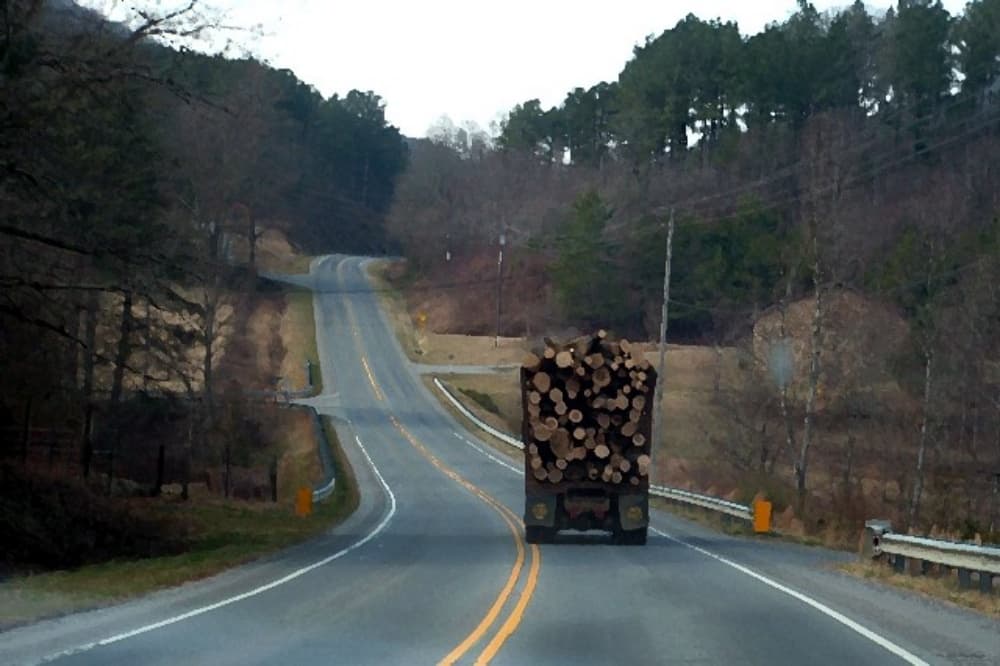
In the past some of the owners of the larger farms during the winter months would have their sharecroppers work at portable sawmills that would be carried and set up in the woods and pulled or powered by a large belt connected to a tractors pto pulley (power take off.) Other tractors were used to drag the logs to the saw and the trucks that were used for farming would be used to carry the sawed lumber to a lumber yard. This was saw timber, not what I knew as pulpwood. Pulpwood in my area was smaller pine trees cut into 5 ft lengths laid across the frame and stacked behind the cab of a an old beat up truck, the larger trucks would haul 3-4 cords at a time to the pulpwood yard that would always be beside a railroad track. As I said yesterday, the wood was cut by men using gas powered bow chainsaws. Nowadays, loggers cutting pulpwood and saw timber hardly leave the seat of today’s modern equipment to do everything from cutting the tree to loading it on the back of a transfer truck like in today’s picture. A chainsaw is no longer needed to be used for much. Pulpwood as I knew it, is no longer cut into 5 ft lengths as it once was.
Ed, I left a comment for you late yesterday trying to explain what I meant by bow chainsaw. For you and others, Google “picture of bow blade chainsaw” and you can see and understand better what I was trying to say. A picture is sometimes worth a thousand words.These saws were back savers for the ones that cut the pulpwood I describe. One of the pictures of a used Sthil bow saw shows the paint wore off and the area of the bow that was used for cutting. Like one in one of the comments, the bow saw got a bad reputation as being dangerous by the ones that didn’t know how to use them. I have used one for many years to cut both pulpwood and firewood, I also carried and used a smaller straight blade saw to cut and work up the tops of the tree used for firewood, when cutting pulpwood you only cut up to the top and left the tops.
Another chainsaw story, two men went together and bought a chainsaw when they first came out after being told how much more and faster they could cut wood. After trying to cut wood with it, they carried it back to the dealer and complained it was no faster than the manual crosscut saws they had been using. The dealer told then he would check it out and reach over and went to pull the rope to crank the saw. The men that had bought the saw looked at one another and said what is that for?
I’ve seen those saws before but didn’t know how they worked. I can see how it would be beneficial if the ground was pretty level and the timber was pulled to you. Mountainside logging is different. We felled the tree, trimmed the limbs and threw them aside and cut the wood in the same 5 foot lengths you did. We had to pitch the piece down a mountainside, to steep for tractors or even animals, to the road. You would put it on your shoulder and with both hands on the end, flip it off your shoulder in a manner that caused it to flip again when it hit. We called it walking it. Sometimes it would walk all the way to the road and sometimes it took several flips to get it there, depending on your experience. When we got it all the landing we would rick it up between two posts in the ground until we had the cordage that a truck would haul. We never had a truck of our own so a chunk of the earnings when to somebody that did.
That don’t seem like a very efficient way to earn a living but “you’ve got to do with what you have to do with”. Hey Tipper, here’s another “words of wisdom” for you!
Ed, I have confused you. The logs drug to sawmills I mentioned was saw timber, not pulpwood, it would be sawed into lumber such as 2×4’s or 2×6’s,etc. Pine pulpwood was 5 ft sticks often hand loaded across the frame behind the cab of a beat up truck known as a pulpwood truck. The trucks would be beat up because of being driven through the woods. The loaded truck would then be driven to pulpwood yards, always beside of a railroad track and unload, the pulpwood would then be loaded later on onto flatbed railroad cars to be carried by the trains to the paper mills. We would use the bow saws I mentioned to cut the tree up wherever it was cut, no matter if it was on a steep hillside or whatever. Pulpwooders would only cut to the tree top. The did not trim and cut the tops, not worth the time for one more stick of wood. When I used a bow saw to cut down oak trees to be used for firewood, I would carry a more common straight blade saw with me to work up the tops. I hope I wrote this well enough to give you a clearer picture.
my Uncle Joe had a strange chainsaw one time, they had a strange bar on it, they had a big space through the middle of bar, The cutting edge was very wide, or long, it was similar to a triangle with round corners,
I’ve heard that one Randy, that’s a good story