
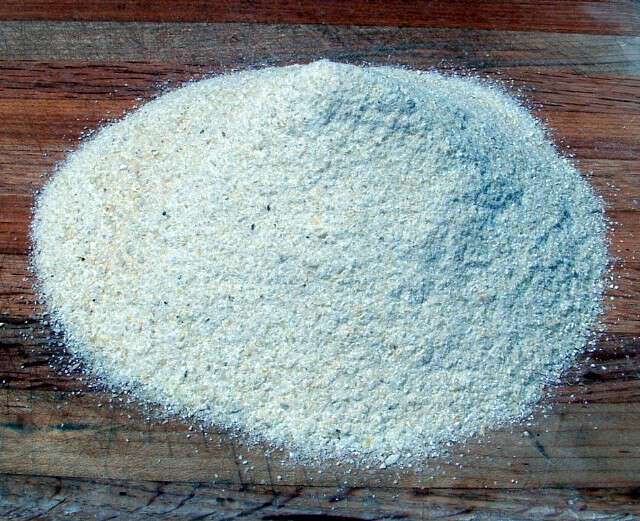
If bread lies at the heart of Appalachian culinary ways, baked goods using cornmeal can sort of be reckoned the mother church of the bread family. Corn as a crop has always been ideally suited to the region’s geography. A patch can be grown almost anywhere there is a piece of cleared ground, from steep hillsides to fertile river bottomland and all types of topography in between. Moreover, corn is a crop featuring exceptional versatility. Freshly picked corn in the form of roasting ears is a summertime dietary treat that can, with successive plantings, be enjoyed over a time span of as much as three months.
The primary usage of corn, however, has always come in its fully matured, dried form. Ideally suited for human consumption thanks not only to its taste but because the grain stores well (corn with the shucks left intact will, if protected from moisture and pests such as rats and weevils, keep almost indefinitely). Historically, it could be ground in small quantities in simple tub mills as well as larger, more complex overshot water wheel operations. This translated to ready production of meal in a process that was appreciably less complex than the milling of other grains such as wheat, rye, or buckwheat. With corn, there was minimal waste. Leavings from poorly formed or inferior ears sometimes called nubbins served admirably as scratch feed for chickens or as supplemental food for hogs in the fattening up times of autumn.
Corn fodder fed livestock and, when stacked in shocks, provided makeshift yet eminently practical means of food storage to protect long-keeping vegetables such as pumpkins, potatoes, and cabbage from freezing during the depths of winter’s cold. Cobs from shelled corn could be fashioned into jug stoppers, carved to make pipes, or soaked in kerosene to provide a dandy fire starter. Corn was, in short, an ideal crop, and that holds true even without venturing into the fabled traditions associated with the grain in its liquid form.
—Celebrating Southern Appalachian Food written by Jim Casada and Tipper Pressley.
Much of the corn grown today in Appalachia is sweet corn which differs from field corn people grow with drying in mind.
For many years Pap and Granny grew their favorite variety of sweet corn, Silver Queen, but also planted a row or two of Hickory King or Hickory Cane which could be dried to use in various ways. Their purpose for drying corn was to make hominy.
Even though the garden is covered with a layer of snow and ice I’m already thinking about the first mess of Silver Queen we’ll be eating this summer.
You can find our cookbook here.
Last night’s video: Getting Stands, Making Trails, & an EPIC Roller Skating Memory from Matt.
Tipper
Subscribe for FREE and get a daily dose of Appalachia in your inbox

The uses of corn cobs in times past reminded me that when my husband’s uncle was demolishing the old farm house after the new house was built, they discovered that the walls had been insulated with corn cobs. And at a Country Buffet’s gift section, I picked up a corn cob with a painted dowel inserted in one end of the cob, labeled and sold as a “Back Scratcher.” When my aunt was still using her old wood stove, she kept a bucket of corn cobs nearby to use as kindling. The stories and goin’s-on in your family are all so interesting. I’ve appreciated your newsletters, the videos and the beautiful music for several years now and hope you’re in it for the long haul. The voices of Pap and Paul blended just perfectly. And it’s amazing to hear Paul and your mother singing together with such pretty harmony. Thanks for all that you do. BTW–here in the S.E. corner of Nebraska, we had 10 degrees below zero the night before last, and the radio said this Arctic Blast was bringing a snowstorm to Florida.
I’m with you, Tipper! It was -10 this morning, and I’m planning the garden! A gardener has to do something in this weather, and dream is all I can do right now!
We will definitely be planting Silver Queen again hoping to get more smut to make huitlacoche. That is so good I rate it now like dry land fish. It’s rare for us to have smut, but the silver queen seems prone to it here in the humidity. We typically plant bodacious and ambrosia for puttin up. Corn is one of our favorite things.
We used to raise Truckers Favorite, Hickory Cane, Bloody Butcher, or Merit. Mama taught me at an early age how to take my thumb nail and puncher a kernel to see if’n it was watery, milky, or doughy.
Well personally I don’t think corn is all it is cracked up to be.
Ed – 🙂
We always grow some corn. when I was a child, we would grind our corn and make cornmeal ourselves. I’m ready for gardening Tipper. lol
I’ve heard it said that corn saved the nation. Native Americans grew it. Colonists grew it. Most Americans eat it in some form–meal, flour, grits, hominy. Yes, some drink a byproduct of it. Corn is also a cash crop and is a staple in animal food. Corn is undeniably a nutritional miracle, and shrimp-and-grits baptized in Cajun gravy takes it to a whole new level. Trust me on that.
My husband and I had the best time watching the video last night. Like Matt, my husband was dropped off at the skating rink in our town.He said “ well we thought we were a Romeo but really we were a zero.” The tick in the hair was just hilarious. Thanks for sharing, we really enjoyed it.
Miss Tipper, I remember having fresh picked field corn. Daddy didn’t have a farm, but good friends that always had extra everything from the garden. It, field corn, sometimes was eaten even for breakfast. Absolutely delicious. When we were grown and informed that field corn was for animals and making various forms of cornmeal, we could hardly believe it. Oh well, I guess all us children, at least seven, sometimes 9, must have seemed like little animals,
“snicker” to momma and daddy. We always had plenty of the gardens bounty in the summertime and fall and never complained. But we sure loved that corn. Y’all here in the south, stay warm and in, out of the attic blast we’re getting this week. Be safe too. This is dangerously cold for all us old folk. Have a great week everyone and God bless y’all today, tomorrow and always. Please remember my friend Sherry, she lost her husband ,this weekend, to a rare cancer. She is a great friend and Jim was too. We will miss him so very much. Prayers up for your Uncle too. My heart goes out to Miss Wilson. Love you all. South Mississippi, Jennifer
Jennifer Lee-I will pray for Sherry.
I bought a small grist mill (turned by a tractor and belt) and ground some Hickory King corn. My parents cooked some cornbread using that meal. My father said that he had thought his wife just couldn’t make good cornbread, because what she made wasn’t as good as what he grew up on. He said that he now realized it was the meal she was using. The home-ground meal was a little more trouble to use because you had to sift out the hulls and it didn’t stay fresh as long, but it sure was good.
Silver Queen is the best! My uncle grew it when he was alive.
I like it all. Years ago i planted of field of tropical corn; bred in the tropics, to be drought resistant. Boy, was it! They told me when i bought the seed, don’t even think about eating it, you can’t get the shuck off and it’s not fit to eat anyway (it’s a silage corn). Of course i had to try it. Stalks were 9′ – 11′ tall with one medium ear. I cut the shucks at each end and the ear just slid out. My wife boiled it and i never tasted better. Never did cream it, i wish i had, and have never found any more seed. One of my favorite breakfasts is pan cakes made from corn meal. I’ve heard them called fritters, corn cakes, i just call them great. Though yeah, sweet corn is sweeter. Love Yellow Jarvis and Merrit.
There could be, and probably has been, a book or books written about corn. I have no idea, for example, how many countries of the world grow it much less how many varieties and how many derivatives. The history of the temperate regions of the world is tied with its bread grains. And about you wanting fresh sweet corn, Tipper, the Native Americans must have so looked forward to that as well because some had a Green Corn Festival along about that time. Reminds me of my wanting to know how to roast corn in the shuck on a charcoal grill and experiment with seasonings like the chili-lime my daughter gave me for Christmas.
Tipper–Randy is exactly right about Grandpa Joe’s rocking chair. As I type this I can glance to my right and there, four feet away, is that storytelling throne where Grandpa held court so many times and filled my boyhood days with so much wonder.
My brother in law grew up”peaches n cream” corn but haven’t seen it in a long time.
Richard, our daughter grew it for us last year as I grew up with it too. I found it in one of the seed catalogs and had to order it. We didn’t want it to mix with our patch so she grew it for us. I reckon we could have spaced out the planting time, but she volunteered.
And don’t forget corn for popping.
I remember helping my uncle hand shuck corn from his field. It was about 3 acres in size and he picked each ear of corn by hand. He could afford paying someone to combine it, but he chose the hand work instead. My guess it was one of his many ways to have quiet time and pray and think about what his next sermon was going to be on Sunday since he was a hellfire and brimstone preacher. Each year when the corn was just right, my dad would pick a few years for us to eat. I don’t know what variety it was, but it sure tasted good. Dad said that the window to pick the corn was only a day or 2 before the sweetness was gone. His corn field was right across the road from our home and my dad eventually bought it from him. I had a lot of fun horseback riding there and fishing in the pond that was on that property. Our uncle allowed us to have access to his properties to ride our ponies or horse and it was pure joy when our dad told us on Christmas morning that he had brought the property from his brother!
For decades, Daddy and my uncle grew about 10 acres of Hastings Prolific field corn. Tall stalks with huge ears. Dozens of ears were pulled and used to put up cream corn and to go in Mama’s soup mix. Even with its large kernel, that field corn made for some mighty good eating.
Once dry in the field, the stalks would be cut, tied in bundles and stacked up into shocks where they would dry even more. When dry enough, the bundles of corn were either taken to be ground into cow feed with molasses added or they were stored to be ground later into cow feed. For many years, the York family of Marietta would bring their grinding machine to different farms and grind the corn into cow feed and bag it in burlap bags. Quite the journey for a field of corn. And, Daddy always kept some of the best dried ears as seed corn.
Eventually, he began to grow Silver Queen for putting up but not 10 acres of it.
My Granddaddy always grew Silver Queen in his garden! It is the best! Have a great day…stay warm!♥️
I guess at one time field corn, not sweet was just about the most important crop grown by a family because of it’s many uses. I have wrote this before, one of my fondest memories of childhood is of being with my Grandaddy Kirby and helping him get up fodder, shocks, and pulling the dried ears of corn. I also remember back in the 50’s of using corn stalks along with some other things for making potato bed for storing our sweet potatoes. Later on the high schools would have heated potato houses. My friend (now dead) had a small grist mill inside a trailer power by an antique engine that he would take to farm shows. He would talk of Hickory King or Hickory Cane corn. One of the earliest varieties of sweet corn I remember was named Bantam, later on we would plant Merit and sometimes Silver Queen. Mother liked yellow corn, Daddy liked white. I now plant G90, it is said to be the closest to Merit. All I know is it sure taste good to me! There are many varieties of sweet corn available today, I looked in the new Gurneys catalog and they were asking $250 for 2 lbs of one variety of sweet corn . They ain’t no corn that taste that good! Tipper didn’t mention corn cobs being used in the outhouse. I have always heard two buckets of red corn cobs and one bucket of white… the white were used to check and see if you needed to use more red!
My Grandaddy carried a broke blade butcher knife in the pants leg of his overalls when he was cutting the corn. The wood handle of the knife was worn smooth as glass. I now have this knife kept in a safe, there is not enough money in the world to buy that knife from me. There are some things in life worth more than money. I bet Jim Casada feels the same about his Grandaddy’s rocking chair.
Randy, I have so many things I feel the same way about, too. A mason canning jar that was my great grandpa’s jar. Bowls from both my grandmothers. My mamaw’s cast iron skillet and canning jars. A gun me and my daddy use to shoot walnuts out of the trees with. A bowl Momma and me always made biscuits in. So many special special things I could go on and on. The greatest gift is salvation, knowing all those I love are with Jesus and we will see them again. I try to remember that greatest gift when the other treasures make tears slip down my cheeks from the sweet memories.