
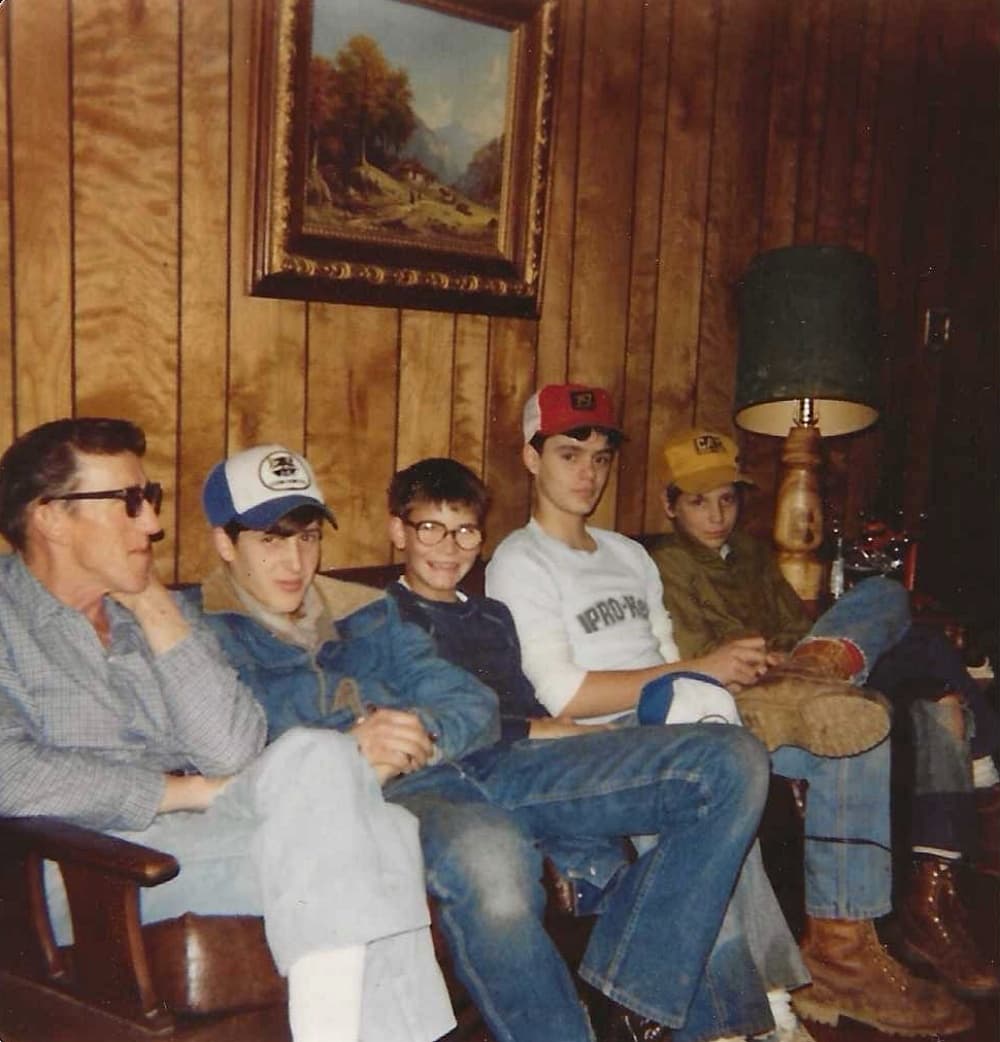
My brother Steve (in red hat) with some of his coon hunting buddies 1980
A recent email correspondence with Blind Pig reader Jim Casada got me to thinking about folks who say heared for heard.
Most of my reference books on language in Appalachia only had an entry for hear tell which is a phrase common in my area and means to have heard about.
There were a few books that highlighted the usage of heared.
heared verb Past tense and past participle of hear.
1813 Hartsell Journal 125 General Jackson fired three Canons off which was the first that I ever heared in my life. 1845 Sevier Co Court This cause comming on to be finally heared and determined before the Honorable Robert J. Anderson Judge. 1864 Wilson Confederate Private 50 (May 22) we heared the cannon plain but we have not heared what was done in the engagement. 1913 Kephart Our Sthn High 120 They’ve heered tell about the judges. 1953 Atwood Verbs East US 16 From c. Pa. to the southwest the form heered /hird/ becomes increasingly common among informants of Type I [i.e. older speakers having little formal education]. A related form /hj.?d/, which obviously results from a shift of stress to the second element of the … diphthong, begins to be recorded in n. W.Va. and becomes increasingly more frequent to the south and southwest; in the mountain areas south of the Kanawha it is almost the only variant recorded. 1973 GSMNP-84:30 I got up here at the gap of the ridge, and I heared them down there, whooping and hollering, and of course it scared me. 1989 Matewan OHP-9 I heared my granddaddy talk about it.
—Dictionary of Smoky Mountain English
heerd, heered, hyerd: [v., variants of heard, have heard.] “‘heerd, hyerd [are both] used by Normal school pupils regularly outside the classroom’ (Joe Morgan of near Asheville) 6 July 1926” (C11). “Ain’t you never heered them call my name?” (J 2:641). “They’ve heered tell about the judges; and they’ve seed the revenuers in flesh and blood.” (B 120). (J 2:367) [See also hearn, heern]
—Smoky Mountain Voices A Lexicon of Southern Appalachian Speech
heerd v. preterit [expressing a past action or state] of hear (rhymes with beard)
—Southern Mountain Speech written by Cratis D. Williams
I also found a short entry for the word in Southern Talk A Disappearing Language written by Ray Cunningham.
The word usage was more common in my area when I was a girl, but I still hear it every once in a while. I mostly hear it from older folks, but I can think of one friend who is younger than me that says it on a regular basis. Interestingly, my older brother Steve uses it but neither Paul (my younger brother) nor I do.
Language is so fascinating. All language is, but near and dear to my heart is the way people speak in the mountains of Appalachia. I love studying on the old way of speaking and in instances like my brother saying heared I wonder who he learned it from and why I didn’t.
Other things to think on are the way words and phrases hold on in certain areas and disappear in others. Much of the unusual usages came with our ancestors from over the water.
The best thing about the mountain dialect is that it sounds like home, comfort, and kinship to my ears.
Last night’s video: Mother’s Day Strawberry Punchbowl Cake.
Tipper
Subscribe for FREE and get a daily dose of Appalachia in your inbox

Has anyone heard this: “that beats all I ever heard tell of”?
Valerie, I have heard it 🙂
Do peach cobblers make shoes for fruits?
It is extremely difficult to transcribe the sounds of our Southern Appalachian language onto paper. It’s left to the reader to attach the proper pronunciation working from their own experience and training. There is where it breaks down. It’s hard to utter a sound you have never heared before, so they substitute something they’re more familiar with. Either that or they call us degenerates and continue on in their ignorant bliss.
Great picture, not a single person was on their phone
I grew up in Raleigh and spend a lot of time in parts of eastern NC. I heard ‘heared’ used all over the state 60-70 years ago. After TV became near univeral in every home, language changed and much of the old speech patterns and words were discontinued.
I’ve heard ‘heared’ used here in Texas, but only among older folks.
At 87, I still “worsh” and “rinsh” my hands. So very happy pockets of our Appalachian dialect still exist •’was truly a wonderful area to grow up in …….. many, many great memories.
god bless you friends please pray for my health, thank you very much, spent the night in the hospital, praise God I didn’t have a heart attack
My grandparents always said heered tell & my extreme North Mississippi relatives still say it. I live in Northeast Mississippi & never hear it here. I enjoy talking to my extreme North Mississippi family & hearing their dialect. Another word my family would say is hep it instead of help it. I can still hear in my mind my grandmother saying I can’t hep it. I always said hep it until a guy I was dating in my 20’s made fun of me so I made a conscious effort to stop it. I miss all the old words my family & others used. I think it is funny that a lot of us Southerners still call folks from the North Yankees. “Yankees” don’t call us Rebels, but still think of us Southerners as rednecks, uneducated, and running around barefooted eating cornbread
It is neat to read all of these comments and how many other people outside of your own family/area have similar things they say to your own family. Both of my parents and extended family, though not from Appalachia, have very similar if not the same language. My MIL was a teacher and my husband, especially when we were first married, corrected (my) language often to the point that I stopped using sayings that were familiar/pronounciations from my whole life. But sometimes “my country” slips out and I didn’t mean for it to. If I get to talking too fast it surely does slip up on me. In some company it can be a bit embarressing for me around where I live now for that to happen too. I have used “heared” for heard just recently and my family just looks at me and smiles and then they laugh – they won’t let it go by without calling me out : ) But like you say, for me too it is like being right back at home- with Mama and Daddy.
I enjoyed hearing you prepare for your Mother’s Day meal and about the recipe you made. Punch bowl cake was one of my dad’s favorites. I need to look up what recipe my mom used because I think she may have used either angel food cake or pound cake, sometimes even a frozen Sara Lee pound cake. I think her punch bowl cake version used cherry pie filling and maybe pineapple and/or sliced bananas maybe, and vanilla pudding if I remember correctly. I will try to find that and let you know how the recipe she had was different. Many of her recipes she got from her sister, some from the ladies at church, and also from the little community newspaper we had which usually had a recipe section featuring someone/food from the community or regional interests. Glad you all had a great day together!
Growing up these ‘different’ way to say words was common, but then seemed to die out with the passing of the older folk, but I still do at times hear them used & have been known to use them myself. I love the many different ways one can say words and when one hears one, it does take you back to a different time for a few moments.
My daughters roar with laughter when I say “heared” or “fount.” My cousin told them we can blame our school teachers because they are the ones who lernt us to talk that a-way.
My grandfather used this all the time. He lived in Rutherford County and his parents were born in Polk County. My heritage includes French Huguenots, Irish with some of the Irish relatives living very close to Scotland. I watch a lot of British tv shows and am starting to see more of the older series. It amazes me how much of their speech reminds me of the sounds of my grandparents and older people when I was small. I like to think that language is the thread that connects us through time….sometimes a stitch is dropped…..but it seems to always get picked up.
I am thinking that he would have “heared” that from one of your grandparents. Probably one that you didn’t have as much time around as he did. Have a great day!
emergency room last night, heart attack symptoms, after taking antibiotics, since I had the c word, in February of 21, strange things happened to me, lots of tests were done in heart attack was ruled out but because of the problem was not determined, I think I have the answer, it’s the c word, god bless you friends
Norman, I’m sorry. I will pray for you!!
thank you
Norman, my sister was in ER with heart attack symptoms the night before you. It wasn’t a heart attack, and her doctor said it was stress. The c word diagnosis is plenty of stress all by itself. Prayers for you this morning.
go6d bless you very much, God bless your sister in jesus’ name, thank you
Thank you, Norman, prayers appreciated and same for you.
Yep, I’ve used hearded many a times, but then I got corrected so I stopped saying it. Once in a while it slipped out. Now I’m retired I let hearded slip out a little more often.
I’ve read surviving letters and diaries of Civil War soldiers using “ heered” along with other phonetically spellings.
I so enjoyed the blog today.
“Once there was a little girl who wouldn’t say her prayers. When she went to sleep at night a’ way up the stairs. Her mammy HEERED her holler and her daddy HEERED her bawl, but when they turnt the covers down she wasn’t there a’ tall!”
I love that you are preserving the language of Appalachia. Here in upstate South Carolina, our cadence has diminished some over time. When far away though, the sound of a voice can make you so homesick. Could you look for entries about the Word “kindly”? My daddy used it to mean “somewhat like.” Another I remember is “loafin'” to indicate being idle, often in response to someone who asked what he was doing.
My granny would use the word heered all the time which was very common in East Tennessee.
Tipper, your video of Steve using his Appalachian language talking about ginseng is one of my favorites!
Everyone have a great day!
Growing up East TN, ” heared tell” was a common discription used to identify sources of events. Our Southland is now invaded with Yankee talk and the old phrases aren’t as common, it brings comfort to these old ears to hear our dialect.
Some of the older members of my wife’s family would say heared or heared tell, along with et for ate and hoped for helped.
I have been reading a book this week titled Branch Water Tales. There are many funny “sayings” in the stories. Some I read last night were about twin brothers that never married and were very close to one another and very tight with their money. They were “they are so close to one another that if one has a cold the other one will sneeze,” and this about their clothes, “their clothes are so ragged, they look like they were robbed off a scarecrow.”
Oh yes, I’ve heared tell of that. I still have friends who speak this way. They’re my age. I also hear the phrase “fer hit’s ” instead of for it’s among the same folks.
Back in the mid nineties, we had a dispatcher who called for an officer to go check on a loose cow. “Fer hit’s in the road”, she said. Everybody loved her!
Personally I think “heared” makes much more sense to use based on past tense endings of verbs. “Heard” is a mispronunciation. LOL.
Yes language is a fascinating thing. And hearing familiar dialects and unique word usages can be comforting.
I’ve often heard people, usually older people, say “hear’d” instead of heard. And hearing the expression “hear tell” or “heard tell” is beyond common to me. So common that I’ve never even thought about it being unusual to some people. One of the things that is so amazing to me is that there are so many words and phrases that I say and have heard all my life that so many other people have never heard and must sound so strange to them.
When I was a young lad, it was very common to hear my paternal grandpa say heared for heard. He never attended school a day in his life, but he married my grandma who was a school teacher who taught grades one through eight in a one- room school house. My grandma would never let grandpa forget that she was more educated than he, and she corrected his pronunciation constantly. Needless to say, it didn’t matter, grandpa never “heared” what she said. This always seemed to cause some friction between the two of them.
This is common for our family.
My husband’s grandmother always stated ‘you didn’t have to hyeerd me’ if someone heard her doing something in private and called her out. They are far south central KY.
My family says it more like ‘hyaird’. They are eastern Ky.
I love the variations of our language. I surely agree, it’s like home hearing the language.