

Yesterday I was reminded of a guest post Jim Casada wrote back in 2012. I decided to reshare it today.
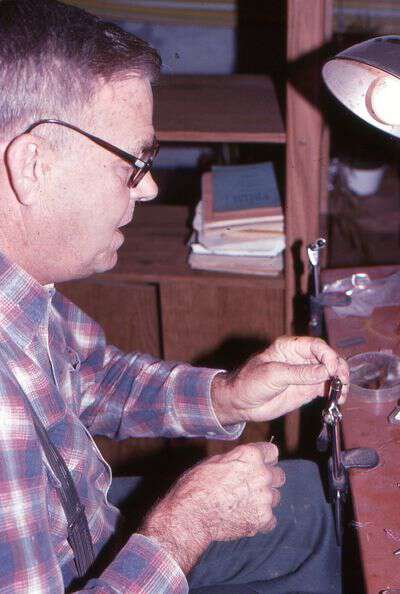
FRANK YOUNG: AN ANGLER FOR THE AGES written by Jim Casada
With Memorial Day at hand, my thoughts turn, as they invariably do, to all the patriots who have served our country over the generations. Each of us needs to recognize and remember these men and women, not merely on Memorial Day but throughout the year. We owe them an incalculable debt and should never forget the sacrifices they made and continue to make.
With that train of thought in mind, I would like to pay tribute to one solider—a simple man of the Swain County soil who also happened to be the finest fisherman I’ve ever known. I first became acquainted with Frank Young when I was just a teenager. Fishing was my life during the summer, and day after glorious day would find me wading the waters of Deep Creek or one of its major feeders, Indian Creek. Both lay within hard walking or easy biking distance of my boyhood home, and their sparkling waters drew me in irresistible fashion.
My path seemed to cross that of Frank Young on an almost daily basis, and gradually we made the transition from exchanges such as “howdy” and “any luck today” to serious discussions of fly fishing. Frank worked at the same place as my father, Carolina Wood Turning Company, but he would hasten home when the whistle signaling the end of another work day blew at 3:30 p.m. He would hastily change clothes, rush to a nearby stream, and get in a few hours of fishing. Over time realization gradually dawned that he was a master angler, and with the eagerness of an eternally curious boy I constantly picked his brain.
Our friendship ripened, and eventually we would take fishing trips together, including one especially memorable backpacking trip in the Smokies. Frank was by that juncture in his life troubled with a bad heart, and in truth he probably shouldn’t have made the arduous trip. Yet he enjoyed himself immensely and those days astream, along with four nights beside campfires talking and telling tales, were filled with magic.
Although I knew Frank had seen military service, it was only during this backcountry adventure that I learned he had been in action in both World War II and the Korean War. Clearly his experiences were traumatic, because he refused to talk about them—not just with me but even with his wife and stepdaughter. All he revealed to me was summed up in a single sentence: “Jim, I came home to fish, forget, and find my soul.”
That’s precisely what he did for decades, right up until his death. Year after year Frank averaged fishing better than 250 days astream. Week days he would be in the water from the time he got off from work until can’t see, and often in the height of summer come can see he would get in an hour or so of fishing before heading off to work. On weekends Frank headed out into the backcountry, usually by himself, with the simplest of equipment. His “tent” was a sheet of heavy-duty plastic; his cooking kit a lightweight frying pan; his sleeping gear a single blanket; and his grub some salt and pepper, corn meal, lard, dried fruit, and dried beans or pasta. Mostly though, he relied on trout and nature’s bounty in forms such as ramps, wild berries, branch lettuce, and the like for sustenance.
Even when it came to fishing gear Frank was a minimalist. Although he owned some wonderful bamboo rods (I am now the proud possessor of two of them), the gear he used was, not to put too nice a turn on it, basically junk. He had taken bits and pieces of fly rods picked up in junk shops or at flea markets and cobbled together his outfit. The reel he used was of the cheapest sort, and he made his own leaders and tied his own flies. Never a man who had much money, Frank was frugal and believed in using what worked—not what cost a lot of money.
A great example came with some of the flies he tied. Certain types of popular tying material have always been expensive, and one of the priciest is “kip tail” –white hair from the tip of a calf’s tail. Frank, in typical fashion, found a perfect substitute. Instead of using the high-priced, store-bought material, he turned to the hair from ‘possum bellies. When he needed material and saw a recent road kill ‘possum, he simply stopped and took what was available. Frank used to laugh as he showed a Royal Wulff, perhaps the most popular of all trout flies, tied with ‘possum belly fur. “If you can’t find plenty of this tying material,” he would chuckle, “then you aren’t driving mountain roads.”
Of all the many things Frank did associated with fishing though, one stands out above all the rest. He always carried a capacious wicker creel with him, and it had uses beyond simply being a place to hold trout he caught. On day trips the creel functioned as a lunch bucket, but its most frequent use involved neither trout nor tucker.
Every time he went fishing, Frank kept an eye out for unusual or attractive sights. This might be spotting a turkey or deer, perhaps seeing a mink swim a creek or a beaver at work, enjoying blooming spring wildflowers or noting ripe serviceberries or blackberries. Or maybe he would catch a big brown trout or break off a good fish. It didn’t matter what occurred. Anything which seemed special to Frank led him to pause, ponder, and reflect on the moment in a thoughtful, unhurried fashion. He was taking an active, carefully thought out approach to something all of us do, but not in quite so orderly or noteworthy a fashion. Frank was making and preserving memories.

Whenever something noteworthy happened, he would immediately look around him in the stream and pick up two or three rocks which were particularly colorful, had unusual shapes, or appealed to him in some other way. Frank then placed these rocks in his creel, carried them for the rest of the day, and took them home with him. There he deposited them in a homemade frame the size and shape of a cement/cinder building block. When the frame was full to overflowing, he would rearrange the rocks, leaving those he found especially appealing sticking out or perhaps organized to make some type of design. He then filled the frame with cement, allowed it to dry, and set the resulting block aside. In that manner, rock by rock, block by block, Frank Young built a house which surrounded him with memories. To me it is a remarkable example of mountain ingenuity as well as a testament to one man’s love of fishing, the mountains, and the good earth.
As a trout fisherman, Frank was simply the best I have ever been privileged to witness in action. He was a wizard with brown trout and had a special knack for catching trophy-size fish. He could cast like nobody’s business, used all sorts of unorthodox techniques, and brought a keen analytical mind to angling. He was also a great fisher of men, or more specifically, boys. Although he never had children of his own, once he returned from the wars Frank devoted untold hours to Camp Living Water, a youth retreat originally founded by Reverend W. Herbert Brown as part of the Smoky Mountain Bible Conference. In fact, that is how I came into possession of the treasured bamboo rods mentioned above.
Somehow my eyes caught a tiny classified ad in the Smoky Mountain Times offering the two fly rods for sale. Intrigued, I called the phone number, which I thought looked familiar. When Frank answered and we had talked for a few moments, I asked: “Why in the world are you selling those wonderful fishing rods?” His response was a moving one to the effect that he didn’t need them but that a couple of projects at Camp Living Water could sure use an infusion of cash. I was more than happy to buy the rods not only as cherished angling items but also because of the wonderful man they came from and the use to which he put the payment.
Frank Young was not perfect—far from it. He had a fierce temper which he battled mightily(and for the most part, successfully)to control. He was haunted by untold demons from the war years, at times he harbored suicidal thoughts, and he could be mulishly stubborn to a degree only someone equally obstinate could understand. A case in point was our protracted argument about whether or not the so-called “Road to Nowhere” in the Great Smoky Mountains National Park should be built. Frank felt that the government’s 1943 promise should be honored. While I sympathized with his vexation over the broken agreement and the wrongs the government had wrought, my view was that constructing the road would be an ecological disaster with one of its biggest negatives being the manner it would affect some of Frank’s beloved trout streams.
Frank persisted in bringing the matter up almost every time we saw one another, and it became a sore spot in our friendship. Finally I called him on the issue. “Frank,” I said, “you aren’t ever going to change your mind and I’m not going to change mine. Why don’t we just agree to differ and drop the whole issue?” For a full 30 seconds I thought he was going to explode. His face reddened and an uncomfortable silence screamed. Then he sort of shrugged his shoulders, shook his head, and stuck out his hand saying: “You know, Jim, for once you are right on the Road to Nowhere. We’ll speak of it no more.” And we didn’t.
If the measure of a man comes in accumulation of wealth or in widespread renown through recognition of grand achievements, Frank Young didn’t amount to much. Yet to me he was a great man—a patriot and member of the aptly named “greatest generation,” a mountain fellow of peculiar yet manifest genius, an individual with an abiding love for the high country, a person with a warm and caring heart, and an angler for the ages. Never do I set foot in a trout stream when I don’t think of him and all the lessons he taught me by example and through quiet instruction. In this Memorial Day period I thought others might enjoy sharing a bit of the saga of a splendid son of the Smokies.
—Jim Casada
I enjoyed reading Jim’s post again. My favorite part is the way Frank collected rocks when something notable happened on his fishing trips.
When I was young I might pick up a leaf or a small rock to remind me of something that happened, but they soon became lost in an old junk box or pressed between the pages of book I might not open for years.
I love how Frank showcased all those memories in the very walls of his house. He built a fortress to remind him on bad days that there was still good in his life.
Tipper
Subscribe for FREE and get a daily dose of Appalachia in your inbox
Thank you so much for the lovely story. My favorite part was also about the rocks.
It’s almost June and it’s been in the low 50’s all day here. I’ve got my heater going. Which winter is this?
Ed-it’s airish here too 🙂 this must be Lynsey-Woolsey Winter which is said to happen after you put away your winter coat and clothes. I’ve never heard anyone say that one, only read about it.
Like many others, I was touched by the story of Jim and Frank. Jim is a master storyteller and I’ve always loved reading anything he wrote.
What a great story. Those are memories to cherish.
What a wonderful writing by Jim!! He’s a colorful writer and I am most always moved by what he writes and how he writes it. I tell myself every day, not just Memorial Day, if not for the men and women who join the different branches of military service we would not be able to live the fantastic lives we all live. My son in law gave 24 years to the Air Force, twice he and my daughter were apart because he was sent to the sand box of the Mid East for darn near a year. That is sacrifice for many men and women, to lose time away from each other. God bless all our Veterans and their families. May He also bless all your followers, Tipper, and your entire family!
This was a great story. Thanks for sharing.
What a beautiful story and moving tribute. I loved what he did with the rocks. Thank you, Jim and Tipper for sharing.
Jim and Tipper, thanks for sharing an interesting, well written story about Frank Young. I’m reading a series of books, Bryson City Tales, written by Doctor Walt Larimore. He writes about his fly fishing expeditions in Swain County with some local expert fly fishermen. Maybe Frank was one of them!
Brenda, I have read this series of books and enjoyed them.
Beautifully written tribute by Jim.
A beautiful story about Frank. So many, even today who come home from war with ‘demons’ they fight the rest of their life. A grandson committed suicide after his 3 times in Afghan. He tried to overcome but the demons would not go. My maternal grandfather was also one who would never share what he experienced in WW1 and he also could have a quick, fiery, face turn red, temper at times. I loved Franks rock memory wall!! Thanks for sharing this Tipper and Jim Casada
What a wonderful story!
Any man who fought in a war should be financially comfortable, if not wealthy. I wish I had known Frank.
Thank you for sharing this wonderful story. My husband served 20 years in the military and was deployed four times. He, also,won’t talk about what he’s been through. I was so touched by the rocks he collected and how he built his beautiful wall with them. What a brilliant idea! I can imagine he would sit by the fire and look around and remember many days/stories as his eyes gazed around him.
Mr. Cassada, you were blessed to know Frank but you know that very well. And I think it likely that you were instrumental in helping him find such peace as he could. Your word portrait is a moving testament to a man and a life lived well, to a place and a time now unchanging, sealed in the past and untouchable by later troubles. What I take away, oddly perhaps, is that your story of Frank and yourself is a love story; love of a Smokes boyhood, of nature, of fishing, of friendship and so much more. Thank you and Tipper for sharing. Good Lord willing, I can hope there will be a very few who will have suchlike fond memories of me when I am gone, not for my honor but for the object lesson about things that matter most. Seems to me that is the point life comes down to.
Ron, I think a young boy can help cure a lot whatever ails an older man. I would bet that truth be told, Frank got as much out of this friendship as Jim did. I believe this would also hold true for an older lady and a young girl.
Your last sentence, I only hope my son and grandchildren have as many good memories of me and the lessons I tried to teach them about their character and ethics as I have had of my Daddy and my Granddaddy Kirby. From reading your comments, I don’t think you have anything to worry about.
Not much interested in the fishing part (though always happy to eat trout) but really enjoyed reading this post. I loved the picture of the rock wall. If I am walking in rocky area, my pockets are overflowing with finds and a creek bed is a treasure trove! The post didn’t mention a “Mrs. Frank” but if there was one she might not have been a fan of the rock wall. I think it would have made a grand shower floor or patio.
What a beautiful story. Those are the kind that I enjoy reading. We have many veterans who have stories about their war experiences, but most are never told. Apparently, fishing was the way Frank relaxed and enjoyed the beautiful mountains around him. Thanks for a memorable story, Tipper.
Tipper I did enjoy Jim’s story about Frank. Thank you for sharing again as I had forgotten about it since the first run. I have several friends that too are haunted by the tragedies of war. They also won’t talk about what happened. God bless them. I also pick up a rock or leaf or twig to remember a place or event I have been to. I love reliving the memories when I think of them. Love to all of you and Granny too!
I really appreciate Jim’s story of his friend. Like you, Tipper, my favorite part was about his rock collecting. Imagine the satisfaction of seeing your walls, day after day, made up of memories from your times outdoors. How very special!
What a beautifully written, well said story about Mr. Young. Thank you for sharing it.
A beautiful story and tribute—Thank you for sharing, Jim and Tipper.
God bless all!!
That was a beautiful story. Thank you for sharing it with us.
I never fished with Frank Young, but knew him in two roles:
1) He supervised a section at Carolina Wood Turning (by that time, it was Consolidated Furniture) close to the one I worked on during the summer of 1971. He was a quiet, patient man who was highly respected by all of the line workers like me. I think Frank not only allowed, but encouraged, workers he supervised to sing while they worked, and boy, could they sing – and it was always gospel songs. For the life of me, I can only remember one of the ladies – Edith (Laws) Watkins the mother of Archie Watkins, who sang tenor, and aunt of Jack Laws, who sang baritone in the Inspirations quartet.
2) But it was around a decade earlier that I’d gotten to know Frank at the Friday afternoon sessions after school where – following in the footsteps of a savior who had made Peter and Andrew fishers of men, Frank was a fisher of boys like me, helping us out with Bible verse memorization program hosted by Camp Living Water.
Penn State offered fly fishing as one possible phys ed course option in 1989, and I took it given the remarkably cold limestone streams that exist in Pennsylvania as well as my affinity for fishing. I learned under Joe Humphreys, where I discovered that the relationship between man and trout is a unique one, both parties committed to the skill of outfoxing the other. Great story Jim, and beautifully written.
What a beautiful story of a troubled man. Trying hard to find his way out of all the pain he went through in the war he saw . I hope he found his way after all the time he spent fishing. What a great story for this morning.
Thanks Tipper
Mike
I enjoyed reading this story. One sentence sticks with me, he wouldn’t talk about his war experiences. I think this is true for most veterans that saw the bad stuff. My uncle was a POW in WWII and he never told anyone, including his wife or daughter what he had went through. All I know for sure, his daughter was 4 years old before he ever saw her. His daughter told me her Daddy would have nightmares from time to time but would not tell anyone what they were about. I had another uncle that was in the Korean War, he came home an alcoholic, but overcame it. He would not watch a movie, the news, or read about anything that had to do with war for the rest of his life. I have always refused to ask a war veteran about what they went through.
Beautiful story
Thank you Tipper, those are the people who will be cherished in the hearts of many but maybe not in the books of history. Thank you Jim for reminding us of those memorable Mountain Americans!