

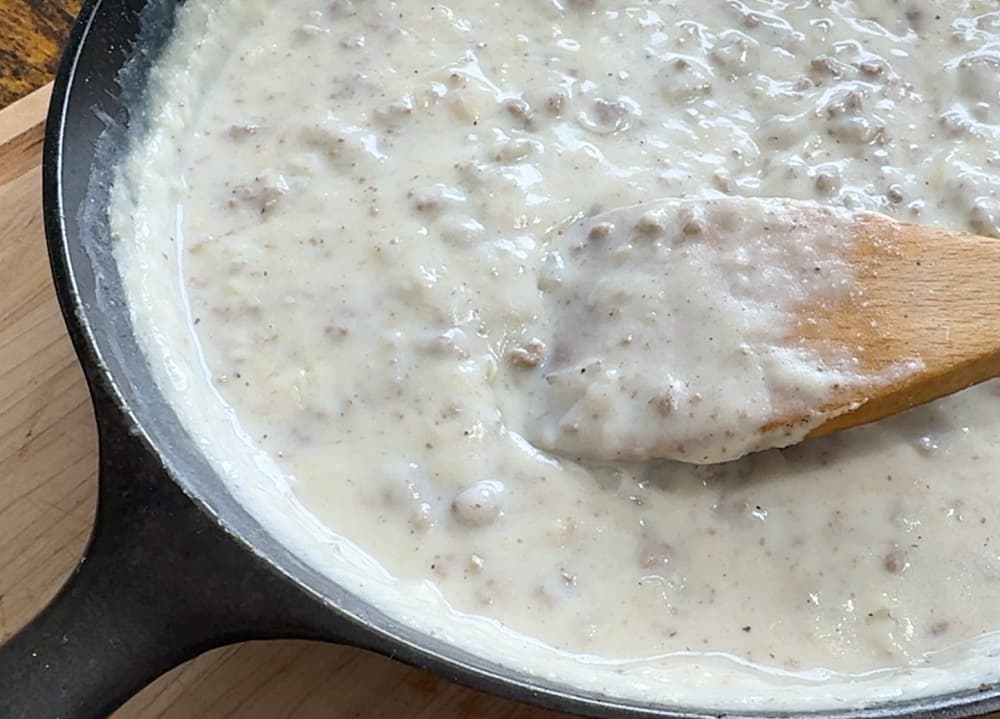
HAMBURGER GRAVY
Many Appalachian families a few generations back were more likely to enjoy the flavor of beef in gravy than any other way. A half pound or so of the least expensive ground beef available (i.e., with the highest fat content) could be stretched a long way when made into gravy and served atop biscuits or crumbled cornbread. It was considered a real treat in my youth, possibly because it was served infrequently or thanks to being a change from the far more common offerings of pork.
- Half pound of ground beef with 25-30 percent fat content
- ½ cup (or more) of all-purpose flour
- 1 cup of milk
- Salt and pepper to taste
Fry the burger then drain the grease and set the meat aside. Using the hot grease as your base, make a roux by gradually adding and browning flour. Then pour in milk a bit at a time, stirring constantly as the gravy thickens. When you approach the desired consistency for the gravy, sprinkle in salt and pepper along with adding the reserved burger. Using milk as your thinning agent, reheat until the meat gravy is just right for serving. You can control the thickness of the gravy by how much flour and milk you use, and if the gravy is relatively thin a little burger goes a long way—and still keeps the taste of beef even though the mixture is mostly milk and flour.
JC
—Celebrating Southern Appalachian Food written by Jim Casada and Tipper Pressley
I didn’t grow up eating hamburger gravy, in fact I’m not sure I’ve ever eaten it until last week. I used Jim’s recipe with a few tweaks and we ate it spooned over cornbread. The Deer Hunter declared it delicious and asked for the recipe to be added to my rotation of often made dishes.
Although hamburger isn’t as cheap as it once was, the recipe still makes a fairly frugal meal when served with cornbread or rice.
You can find our cookbook here.
Last night’s video: Matt Cooked Breakfast on the Woodstove, Family Jokes, & Weird Drinking Glasses.
Tipper
Subscribe for FREE and get a daily dose of Appalachia in your inbox

That was never on the menu at our house growing up. As a matter of fact, I was in my teens before I’d heard of it and thirty-one before I ever tasted this dish. I was at a WW2 re-enactment in the mid-90’s at Fort Indiantown Gap, PA. The fort was built as a WW2 training base, but has since been used for a variety of things from housing Cuban refugees to now being used as a PA National Gurard Traing base. Anyhow, the promoters, in the spirit of authenticity, choose this as one of the entrees for he morning meals because of it’s infamous association with the U.S. Army. My grandaddy, who was a WW2 veteran, always talked about hamburger and gravy served over toast referred to as SOS (if you don’t know what SOS stands for, ask an older veteran). My grandaddy said he’d eat it, but it wasn’t his favorite. It tasted alright to me and I can see the caloric, comfort, simplictic values, as well as the frugality of the meal. I can see where it’d be great meal for a cold winter night, but could prove a might “heavy” for me during warmer weather. Speaking of weather, ya’ll wll be feeling the cooler temps (if you didn’t yesterday/last night) that blew into northwest Alabama yesterday evening. It isn’t a true cold front, but it is a welcome relief to the brutally hot days we’ve experienced he last three weeks or so. Enjoy it, for I know that summer is not yet through with us.
I remember many nights when mom came home tired from work. She made a quick hamburger gravy, threw in a bag of frozen mixed vegetables, and we had this over boiled potatoes. We all came to enjoy this simple meal very much and now it brings back fond memories.
I forgot to mention, we get the roux a bit more brown for more “beefy” taste. For us, the lighter gravy is for sausage gravy on biscuits. Reckon there’s a lot of different way folks do it though.
I’m an old hillbilly transplanted to the Great Allegheny Plateau in NW PA. My Yankee wife probably only married me for my biscuits. Anyway the wind is howling this morning like nothing I ever heard in my mountain holla – reckon it’s because there ain’t any hills between here and the North Pole 🙂
You solved my dilemma for what to make for supper this evening. We add and onion and serve it over mashed potatoes, and my family has always called it “Bobcat Special” for obscure reasons.
Thanks for the supper idea!
I did grow up eating hamburger gravy and have been eating it ever since. I usually add chopped onion to the beef when it’s browning, and I use garlic salt & pepper. I used to prefer it on mashed potatoes, but since I developed a sensitivity to potatoes (), I usually have it on rice. Pure comfort food.
I love hamburger gravy. Made it in my earlier years when I had to be frugal. I enjoy it still, but because I choose to be frugal! Ha! But sausage gravy is my first choice.
i remember drinking from the same type of glass (did Matt refer to it as on a foundation or pedestal)—my sister had a set of them. I always enjoyed the uniqueness of the design.
But I’m jumping to a different subject—sorry, it’s a long comnent:
Tipper, fresh ginger has been one of my most favorite taste sensations for decades. I grew up with powdered ginger as a kitchen spice. But as a young adult, I was introduced to the fresh root by eating what became one of my most favorite restaurant dishes at a very small, independently-owned Szechuan restaurant—it was loaded with a lot of diced ginger root. I was immediately hooked!
Watching your YT videos, making or referencing the probiotic or fermented flavored waters, you’ve commented how you enjoy ginger.
Several years ago, a cousin ordered me a Good Housekeeping magazine subscription as a Christmas gift. In one of the first months of the subscription, there was an article on growing ginger.
I was so eager to try it. It was unbelievably easy, and it was amazing how quickly it seemed to sprout, grow, and spread. And the first time I harvested some, it, too, was so easy. Such an exciting experience.
I’ve inconsistently had small gardens or just gardened in containers, I’m nowhere near a seasoned gardener like you (and your dearheart/sidekick), but I think raising ginger root has probably been one of my favorites.
I encourage you to try it. I think you will find it rewarding. This is something you could start at any time, and have it all year long, most likely.
I lived in central Illinois when I started it for the first time and had no green house, heat pads, nor grow lights. And it sprouted in very little dirt as Sharon Tregaskis states in her article.
For your convenience, I’ve provided the link to her article as well as copied and pasted it in its entirety below.
Hope you try it with good success!
from Karen
https://www.goodhousekeeping.com/home/gardening/a20705827/how-to-grow-ginger/
Even apartment dwellers can plant this container crop.
BY SHARON TREGASKIS
UPDATED: JUL 29, 2018
Cuttings from the lush, bamboo-like foliage lend fresh flavor to tea or soup stock, and simply rustling the leaves as you pass by releases a heavenly scent. While most American grocers sell only cured ginger — harvested from steamy parts of the globe like China, India, and Nepal — a growing number of specialty growers throughout the Northeast (I’m one of them) harvest baby rhizomes in late autumn.
Here’s how you can grow your own ginger outside of the tropics, too:
Find a Root
Buy a piece of ginger the size of your thumb with several bumpy nodules at the tips — these are the buds. Opt for plump chunks, not those withering in their own skin. Skin on the delicate buds should be thinner and lighter colored; forego pieces with darkened buds.
Like potatoes, conventional ginger is irradiated and treated to stop it from sprouting at the supermarket. That means it won’t sprout in your home, either. Choose organic.
Encourage Sprouting
This is the hardest part. Ginger takes its time getting started. To speed it along, create a terrarium using a takeout container with a clear lid. Choose one just a few inches larger than your seed and punch drainage holes in the bottom.
Put an inch or two of potting soil below the seed and sprinkle just a half inch above. Water well. Replace the lid, but don’t seal it. Maintain the soil at 70 degrees and moist to the touch, watering only when the soil dries. A sprout will emerge in six to eight weeks.
Plant in a Large Container
Ginger is a heavy feeder and an even heavier drinker that needs a lot of room to grow. Given the space, a chunk the size of your thumb will easily grow to fill a 2-gallon pot over the course of about six months. Choose a pretty container with good drainage holes and a deep saucer.
Use well-draining, fertile soil with plenty of coir. Gently place your pre-sprouted rhizome on top of 4 inches of soil and bury all but the sprout tip. Place it in a warm, sunny window or in a sunny, sheltered spot outdoors where temperatures range 60 to 90 degrees.
Hill the Soil
Like Irish potatoes, ginger rhizomes will burst through the soil and turn green in the sun. Commercial growers boost yields by watering regularly and hilling the rhizomes once a month. To achieve the same result at home, water weekly with organic plant food and once a month sprinkle several inches of rich compost into your pot, protecting the rhizome itself from solar exposure.
Harvest
Hold the greens at their base, where they emerge from the soil and lift the entire rhizome. (This is a good project to do outdoors over an old newspaper or drop cloth.) Snap off a chunk of the rhizome, then place the rest of the plant back in its pot, sprinkle on more potting soil or compost, water heavily, and treat it gently for a few days. Like any fragile transplant, protect it from glaring sunlight and wild temperature swings for a few days while it recovers.
Enjoy
Baby ginger has a mild flavor and unlike its cured counterpart, it’s juicy with more snap and less string. Best of all, the skin is so thin and pretty, there’s no need to peel. Sauté it with veggies, steep slices in hot water with lemon and honey for a soothing tea, or toss chunks in the juicer with apples, carrots, or kale. Feeling adventuresome? Create an infusion with your favorite libation, steep in simple syrup, or candy it by simmering in sugar syrup.
Karen-thank you!