
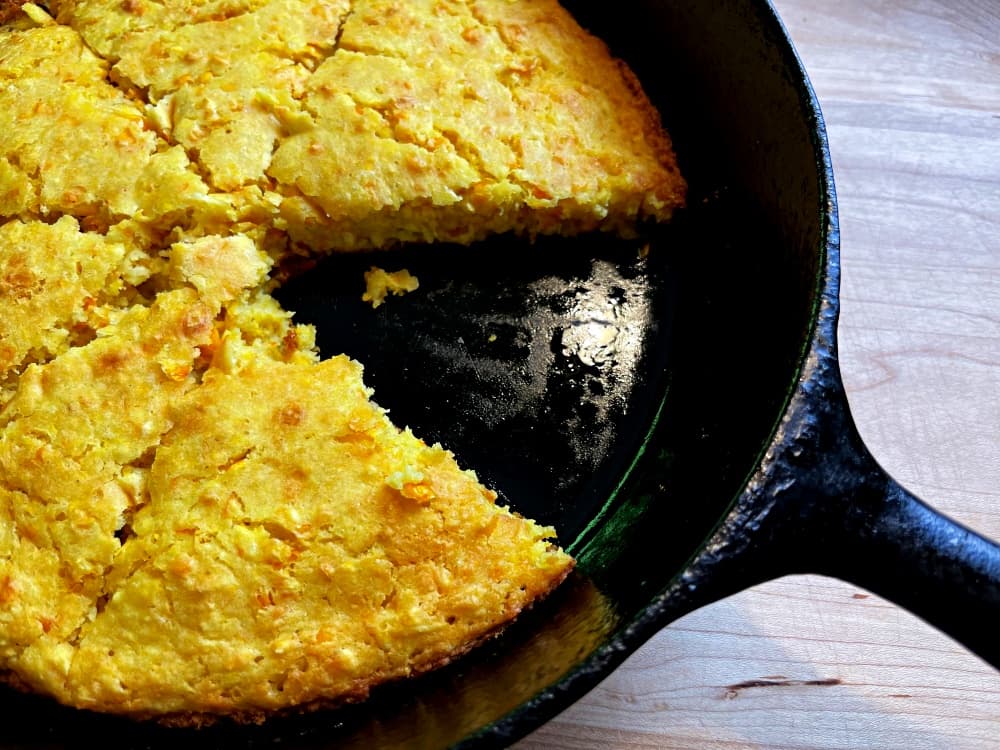
gritted bread (also gritting bread, gritty bread) noun Bread made from semihardened kernels of corn grated into a coarse meal; the texture of this bread gives it an appealing taste.
1892 Allen Cumberland Gap 252 A simpler way of preparing corn for bread than by even the hand-mill is used in the late summer and early autumn, while the grain is too hard for eating as roasting ears, and too soft to be ground in a mill. On a board is tacked a piece of tin through which holes have been punched from the under side, and over this tin the ears are rubbed, producing a coarse meal, of which “gritted bread” is made. Much pleasure and much health they get from their “gritted bread,” which is sweet and wholesome for a hungry man. 1913 Kephart Our Sthn High 291 The ears are grated into a soft meal and baked into delectable pones called gritted bread. 1930 Thomas Death Knell When roasting-ears have passed the soft, milky stage, but are not yet hard enough to grind into meal they are grated and baked into a delectable pone called gritted bread. 1931 Professor Learns “Here, I brought you a turn of fresh water-ground meal,” he said. “I’ve been up Buffalo fishing and got it at the Laytown Mill. Bake you a hoe-cake out of it. It’s so fresh it will taste like gritty-bread.” 1957 Broaddus Vocab Estill Co KY 37 gritting bread = gritted bread. 1975 Purkey Madison Co 60 As soon as the first corn ripened, but before it was hard enough to shell, my father grated it on the big tin grater. He had made the corn grater by drilling nail holes in a piece of sheet iron, then fastening the tin in a half-circle to a large board, leaving the rough side exposed for grating. Hot gritted bread spread with freshly churned butter was a treat to remember. 1976 Braden Grandma Was Girl 29 Sometimes in the fall, we ran out of meal before the new crop of corn was hard enough to shell for the mill. Then we would grate some of the new ears to make “gritted bread.” It was good bread. The grater we used to make this soft meal was a piece of tin full of nail holes, nailed on a board with the sharper points of the holes up. 1986 Pederson et al. LAGS (Scott Co TN) = scalded corn bread. 1990 Oliver Cooking Hazel Creek 9 One culinary pleasure in the late summer was gritted bread. It is made from corn that is too ripe or hard to be cut from the cob and fried or stewed, and yet not dry enough to be shelled. Moisture or milk still remains in the kernels, making them soft enough to be grated or gritted, as it was pronounced, from the cob. 1996 Houk Foods & Recipes 44-45 Past the roasting ear stage, the milky kernels were grated off the cob and baked into a mountain specialty, “gritted bread,” or a cook might stir up a “run” of cornmeal mush. 2002 Myers Best Yet Stories 112 Corn, which had grown too hard for frying or creaming, was grated and baked into what was called gritted bread. The grater was a kitchen utensil made from wood and a piece of tin. Many nail holes were driven into the strip of tin. This strip was then fastened in a circular or rainbow fashion to a larger piece of wood. 2003 Howell Folklife Big South Fork 60 Gritted bread could be made late in the summer when the meal from last year’s harvest might be running low. That recipe replaced meal with grated corn which was past the roasting ear stage, but still milky. 2009 Shelton Gritty Bread 28 No one in my family knows the exact origin of Gritty Bread, a recipe that made use of the bounty of the garden and the pasture field. Field corn, used to feed both animal and people, was the main ingredient. It was tougher than the sweet corns of today. Grating it for Gritty Bread made it more palatable and easier to cook.
—Dictionary of Southern Appalachian English
A few folks had questions about yesterday’s post on gritted bread so I thought I would share the dictionary entry.
I first learned of gritted bread from Pap. He told me about two different types of gritted bread.
The first was the recipe I shared with you yesterday. The other gritted bread used corn that had dried enough to be shelled off the cob.
Pap said families would sit around at night and parch corn over the fire and then eat it as a snack kinda like we do popcorn. He said it wasn’t unusual to be standing around talking and see someone pull out a little bag of parched corn to eat.
The other recipe for gritted bread Pap told me about used parched corn.
Folks ground parched corn by various methods and then made a bread with it. Parched corn made for a much coarser meal than what was made at the local grist meal. Pap said folks would sift out the largest pieces, but it still made for a grittier nuttier tasting bread than using corn that was just past the roasting ear stage.
One year Pap helped me make parched corn and the two types of gritted bread from field corn he grew. The gritted bread recipe I shared yesterday was by far my favorite of the two and it works well with sweet corn too.
Tipper
Subscribe for FREE and get a daily dose of Appalachia in your inbox

Tipper – in case I missed it in reading yesterday and today’s posts, where do you get the gritted cornmeal or do you grind your own from corn you grow? My mother used to buy Lamb’s stone ground cornmeal when she could find it at the grocery store and made cornbread with it for everyday meals. It was a courser ground meal. She never used it when cornbread dressing though.
Nan, yes I use the corn we grow for gritted corn. I don’t know that you could buy gritted corn, but you can certainly buy corn by the ear and make your own with a grater.
When corn was a little too hard to boil or cut off and cook in a skillet, she would always bake the ears in the oven. we loved it!
Although my family grew corn for 3 generations that I experienced, I have never heard of gritted corn bread; nor have I heard of corn silk tea or using the cobs for jellies. Fascinating! I would like to know how those are made.
Although I ate commercial “Corn Nuts” until my dentist told me to stop, I had not heard of “parched corn” until Blind Pig taught me about it.
I keep thinking I’m like the Blind Pig in that there’s so much good information around but I’m ignorant of it until someone like Tipper puts it under my nose! Thanks Tipper!!
I would have had the same thought about scraping oneself making gritted bread with a homemade grater. But watching the video you sent me, I see the cob serves as a handle and keeps the fingers away from the “teeth”. You also remind me of something I often forget and that Jim C. mentioned. Some folks had home hand-cranked mills, one heavy duty one for corn and the light version for coffee are two examples. I for one am so use to powered machines in my lifetime that I have to be reminded that not so very long ago there was no “grid” to get off of. But there were lots of inventions to do jobs, invented by people just solving a problem. I cannot recall ever having seen any emphasis on that phase of history between the steam engine and the gasoline engine. I wonder if there was a hand-crank mill that would have “gritted” corn if the moisture content was just right. I’ll bet there was and probably several makes. I think maybe there were versions that allowed exchanging grinding heads.
I had never heard of gritted corn growing up but learned about it working in primitive museums in my adult life. I’m sending a picture of a gritter from a book, although the gritters I’ve seen are simply a rectangular piece of tin with nail holes punched in with the rough side out. The tin is larger in length than a large cob of corn. It is bent over a board which is a little larger in length and about an inch thick. The edges of the tin are nailed to the sides of the board forcing the tin to curve above the board, similar to a nutmeg grater. I couldn’t find a picture in Foxfire or other books I have. I suppose a gritter was so simply made they were not a valued item to preserve as many items were for so many people. You are making me hungry!
Sallie–
I don’t, hardly ever, hop on here to ‘Reply’ to a comment (due to the format…*which I think is beautiful!), BUT EVERY WORD of your comment, I “second”! I completely agree w/your sentiment!!
Now “apple-head dolls”. I would love to see a pic of your dolls! My connection to them is small, but seeing your name above your comment brought an old memory close to heart. About 48yrs. ago, my youth fellowship group made a trek from Upper NY, to [Henderson] Kentucky and the Red Bird Mission. We were in Henderson to help clean-out homes following a historic flood, but we slept up in the mtn., at Red Bird. . . It was there that I saw, and was taught how to make apple-head dolls, and cornhusk dolls (along with “gee-haw whimmididdles”. I wonder if you know THEM). I love the *individual character of each apple-head dolls! I spent the entire Fall, back home, making apple-head dolls! My first attempts looked very “witchy” but by the end of the season they were quite endearing “old folks” and I loved each one.
Thank you for the trip back to this craft and the mountains of Kentucky!
I remember eating parched corn as a child. It was a treat although a little hard to chew.
Good morning Tipper – your cover picture makes me wish I could pull it off the page and try it! 🙂 I have heard of cornbread/pone and love it, as well as cornmeal mush, but never heard of ‘gritted bread’ until you. You are such a wealth of information and always teaching/showing/reminding us of something new. Hope you & Matt have come up with something special to celebrate your BIG day tomorrow! Celebrate the two of you and your blessed marriage. Not everyone has what you two have. Praying for strength, comfort & peace for Granny.
I bought a bag of expensive cornmeal at the grocery store, thinking that because it was identified as coarse cornmeal, it just might make gritted bread. It did not; it actually had the consistency of small pebbles that nearly broke my teeth. After reading your post and seeing the picture of the delicious-looking bread, I was tempted to grab a couple of ears of the field corn grown here and try it to make a pone of bread for supper. On second thought, I think I will stick with store-bought cornmeal after remembering how I watched weedkiller, fertilizer, and other chemicals being sprayed on the fields several times this season. Not to mention how I would lose my appetite if I found deer slobber on an ear.
The FDA allows 1 rodent hair per 25 grams (3.1 tbsp) of commercial cornmeal mix. I would extrapolate further on FDA allowed foreign substances but I don’t have the stomach for it.
Store-bought cornmeal starts out as the same corn with the weedkiller, fertilizer and other chemicals you are trying to avoid. If you want the cleanest and least chemical ladened corn grow it yourself or buy it dried in the shuck from a local farmer and grind it yourself.
Tipper and Matt,
Please pray and ask your readers to pray for my niece Shanna Reagan. She is a daughter of our Lord Jesus Christ and a great witness. She has battled many battles concerning her health. She is about 38 years old and has 2 children. She and her son both have a genetic disorder that is taking her vision. She has been in the hospital for over a week. She had fluid in her stomach. They grew it to see if her shunt had bacteria (just had it worked on again). The good news was that it didn’t grow anything. It could have went to her brain. They are going to shut it off Thursday when they do surgery again and take it out and send it off to make sure there is no infections. They will put her on antibiotics. If her spinal fluid builds up in her brain again causing pressure around her eyes, she is to call and get to the ER ASAP. The pain is unbearable. I got a call yesterday and she was so spiritually up because she got to witness to a young Christian lady who was struggling. Thank you all. God bless.
Drama, I will pray for Shanna.
And I just did. I know what it’s like to be in her position and what it’s like to watch someone you love struggle. Jesus knows.
Thank you Tipper. I hope granny is having a great healthy day. I know you all cherish every day with her. I would love to tell my mom how much I love her and thank her for her unselfish love toward all of us kids. Do you have a neighbor called Reggie? He drives a propane truck. My son Jason works on his truck at T&T Fleet Services in Knoxville. He said his girls went to school with Katie and Corrie. Thank you all again for praying for Shanna. God bless.
I remember my mom talking about my grandma parching corn in the evenings for a snack sometimes. Sounds tasty. And so does your gritted bread.
Randy–All my early (and scrumptious) exposure to gritted bread used field corn such as Hickory King and Hickory Cane. I’m pretty sure that’s all my grandfather grew, although my father grew sweet corn. Grandpa just had several successive plantings and we would enjoy roasting ears throughout the summer. What wasn’t harvested before turning starchy, and field corn is only sweet for a short time, or used in the early starch stage for gritted bread hung on the stalks until well into the fall when it would be gathered for hog and chicken feed.
Although Grandpa Joe grew yellow field corn, the gritted bread was always from white corn. He adhered to the old-time wisdom of “white for folks; yellow for critters.”
I actually prefer gritted bread from field corn, although other than the fact that maybe it has a bit more “body” and my disdain for Yankee cornbread (cornbread ruined by the use of sugar) I can’t exactly explain why.
Jim, I had a very close friend (Jack Brock) that owned a small grist mill powered by an antique one cylinder engine mounted on a trailer that he would carry and demonstrate at antique farm shows. I have heard him mention both the Hickory King and Hickory Cane corn. Did either one of these have red cobs? I am in full 100% agreement with you about Yankee cornbread, if I want sweet, I will eat pound cake! Look up Marsh Hill Mill, Edisto Beach, SC and read about how Jack got Greg the owner started in his milling business.
I remember mommy making corn meal mush and she was crazy over it! To me it was “really porridge” like a fairy tale and I was not gonna eat that mush. That was my child thinking and looking back on it, I should’ve tried it maybe. You wouldn’t have one of those tin corn grinders to show us would you? I’d love to see one and I wonder how folks didn’t get cut by such a device…it sounds dangerous to get off the ear, but worth the risk when I hear all the wonderful things said about gritted bread…it’s a pretty pone and looks very appetizing. You live the high life, girlie! You really do live a good life! Have a great day, Tipper! That’s a good name for you cause you certainly are the very tip top!!!
Sadie, I don’t have one to show, but I wish I did 🙂
I didn’t question you yesterday. If I read yesterday’s post correctly, you used your “hard” Silver Queen sweet corn to make the gritted bread. I know your corn was not completely dry. In both of the methods you mentioned today, it seems like “field corn/ mule corn” was used. Back in the past times I don’t think there was the many varieties of sweet corn that are available today, the first I ever heard of was named “Bantam corn.” Does using sweet corn change the taste?
Randy, yes sweet corn works well for the type of gritted bread that uses fresher corn. Since that’s what we grow that’s what I use 🙂 The bread is about the same but sweeter. I don’t think sweet corn would work for making parched corn as well as field corn.
I had given up on sweet corn but you inspired me this year to go hunting for a local source I could trust. The racoons in my area have been known to climb electric fences so I didn’t even try to grow. So thankful. I froze, canned and ate a bunch and dried the silk for tea, cobs in freezer for jelly. Delicious. May have to seek out some corn to try this recipe. Sounds really good.
I would really appreciate more information about your use of silks & jobs.