
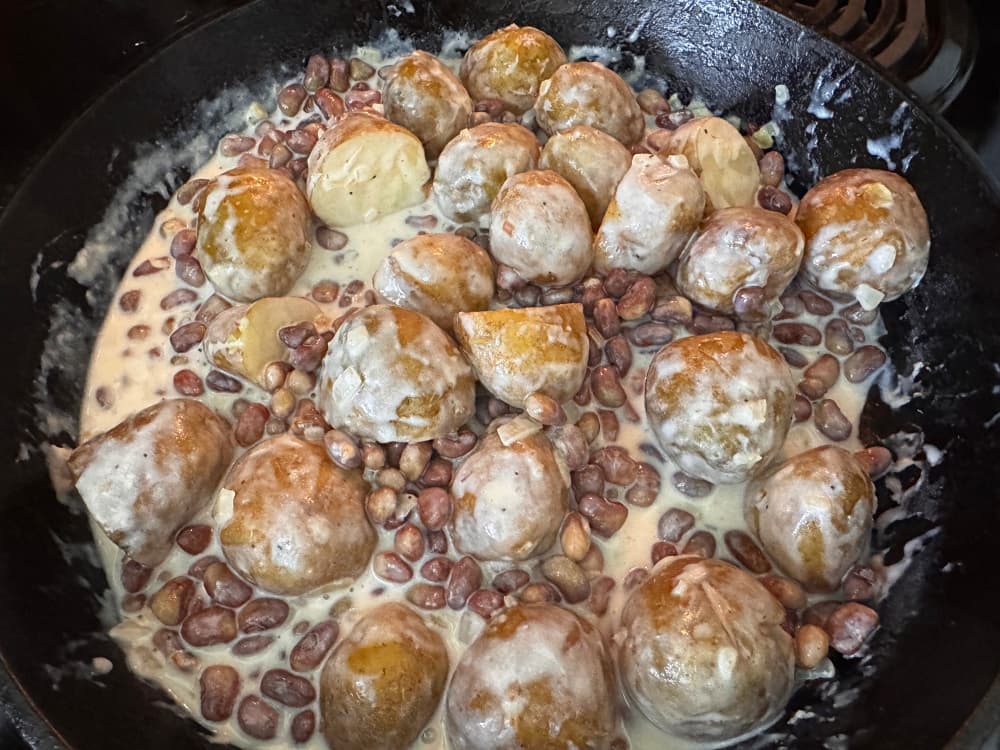
CREAMED PEAS AND NEW POTATOES
Both peas and potatoes have long been favorites in mountain gardens, and for many generations the latter, thanks to a combination of productivity (you can grow a lot of potatoes in a relatively small space) and keeping qualities, was a staple vegetable perhaps second only to corn in overall dietary importance. Fortuitously green peas and potatoes reach the edible stage about the same time in late spring, and combining them in a delicious dish was commonplace. In today’s world you can buy new potatoes at any time of the year and frozen English peas make the other part of the classic combo something that can be enjoyed through all seasons.
The “creamed” can be a bit misleading, since no cream, just milk, is involved in the dish. Keep in mind that this is a foodstuff, unlike so many, which tends to be lacking in salt. That’s because there’s no salt, other than the small amount present in salted butter, present in the ingredients. You can adjust salt and pepper taste if the amount suggested leaves the vegetable mix tasting bland.
- 12 medium-sized new potatoes
- 1 cup fresh or frozen garden peas
- 1 tablespoon salted butter
- 2 tablespoons diced sweet onion
- 1 tablespoon all-purpose flour
- 1 cup whole milk
- 1 teaspoon salt
- Ground black pepper
Scrub potatoes with a vegetable brush to remove skin or else wash carefully and leave skin intact. Cut in half unless some are quite small. Mixed sizes will be the case with those dug from the garden while grocery store ones will have relative uniformity. Place in enough boiling water in a saucepan to cover and cook until barely tender (about 10 to 12 minutes—you can test with the point of a sharp knife), drain in a colander, and set aside. Cook peas in another saucepan of boiling water (required time will be less, perhaps 5 minutes) and drain and set aside as well.
Melt butter in a large skillet and add onion in medium heat, cooking until translucent. At that point add flour, stirring constantly with a whisk, and cook for a minute or so. Then slowly add milk, again stirring all the while, until everything is well combined. At this point add peas, potatoes, salt, and black pepper. Reduce heat to a slow simmer and allow to thicken until the sauce is slightly creamy. Adjust salt and pepper, by taste testing, adding more if needed. Pour into a serving dish or bowl and enjoy. This makes a hearty main dish for an all-vegetable meal or a grand side dish with fried or roasted chicken.
JC
—Celebrating Southern Appalachian Food written by Jim Casada and Tipper Pressley
A few weeks ago I made this recipe for the first time. Oh my it was good! We used heirloom peas called calico that a friend shared with us. For the potatoes we used ones we grew this year.
I cooked my peas and potatoes a little longer because I like them both on the soft side and I used more than a cup of peas. Recipes like this one can be massaged here and there to better fit your prefrences once you have the main gist of it down pat.
Granny tells a humorous story about getting foundered on new peas and taters. You can hear her tell it here.
You can find our cookbook here.
Last night’s video: Working on the Shed…Matt Hopes to Finish it Before His First Social Security Check!
Tipper
Subscribe for FREE and get a daily dose of Appalachia in your inbox

If you take the recipe for the cream sauce, add in sugar and subtract the onions, you’d have Granny’s sauce for fresh picked lima beans. She’d cook them up soft, drain them and then add the cream sauce. If she was out of milk, she’d use the condensed sweetened milk and less sugar.
I almost got floundered on new English peas when my Aunt fixed them for me many, many years ago in my teens. Oh sooo good!
On another subject that you mentioned about painting your cabinets white. They look nice but I absolutely love natural wood. I have cherry cabinets in our kitchen and my Son tore out all the very old painted white cabinets in his house and made his own out of Oak. They are beautiful! Today it seems like all the ads on television where decorators are trying to sell people on blue cabinets, yellow cabinets, etc., but to me I love the true color of the wood. I sure enjoyed hearing the girls playing and singing too.
Tipper – another comment as I forgot to add it in my first one: I have often had creamed green peas, and creamed taters – but never combined together. It has only been with you that I even knew there was any other ‘pea’ but green!! Like, where have I been living all my life!! ha ha I always thought if it was brown or red or black or white or pinto etc. it was a bean. Even the black-eyed peas I thought were more of a bean then a pea. BTW creamed carrots are very good too. 🙂
I don’t recall being ‘foundered’ but it sounds very unpleasant! If I was picky about eating anything, mama always said I had to eat at least a tablespoon of whatever it was whenever it was served – and it worked as I eventually came to like whatever it was that I was being picky about!
Tipper – an oddity that makes me go ‘hmmm’ as I did click the link to watch Granny sharing about being foundered – I knew I had watched it before, and although I never commented at the time, I had clicked the thumbs up, but this time, that thumbs up had been undone – so then I went on to watch another older video I had seen before – that thumbs up had been undone as well. I have found this to be the case many times in the older videos I have re-watched and given the thumbs up /liked. How come the ‘like’ or ‘thumbs up’ get undone – do you know?
Crowder peas, field peas, black-eyed peas, and purple hull peas are not peas at all. They are technically in the same family as beans. English peas (green peas, garden peas, shell peas), snow peas and sugar snaps on the other hand are true peas.
I think we have discussed “new potatoes” several times before but it is worth rehashing. Merriam-Webster defines a New Potato as, “: a small moist tender thin-skinned potato harvested early in the growing season”. Other’s also describe it also as an immature potato. New potatoes are harvested earlier before their natural sugars have been converted to starch.
New potatoes have a very thin skin and the flesh is watery compared to mature, cured potatoes. As soon as the tuber is detached from the root is begins the process of what we call “curing”. The skin thickens, the points of attachment heal over and it begins to lose some of the liquid. Within a few days the tuber has become a generally smaller mature potato.
So called New Potatoes from a grocery store are anything but. Some are culls from huge farms that seek to grow larger potatoes. Lately there has arisen a niche market for smaller whole potatoes but these are fully mature. Potato farmers and grocery stores have seized on an opportunity to sell an otherwise rejected product at a higher price point.
New potatoes, fresh from the ground, have a distinctive taste especially if “creamed” with milk, flour, salt and pepper as in the recipe Mr. Casada has written. Don’t get me wrong, I love English peas and I love new potatoes but mixing the two one detracts from the flavour of both. That’s the way my taste buds work anyway.
If you have the opportunity try going to the garden early in the season and dig some immature potatoes. Immediately clean and cook them in salted water until tender (takes much less time than cured potatoes), mix the milk and flour together into a thin paste and then slowly stir into the potatoes. You can leave them whole, smash them with a fork or potato masher or whizz them with an immersion blender. It’s your choice! Add fresh ground black pepper at the table, the more the better for me.
It’s a culinary delight that can be experienced by only a few in modern society. Sad!
One of my all time favorite dishes but have not had in years–I just can not get mine to taste as good as mama and grandma could theirs so I think I will just continue having that sweet memory of eating theirs in my mind and not muddy the waters with sloppy seconds of the taste of mine lol
Hope Granny has a comfortable week–praying for her and your family
My mama always made creamed new potatoes but never with peas. Her favorite dish to make was creamed tomatoes. I love potatoes, tomatoes and peas, but I don’t love any of them creamed. My hubby’s Italian grandma always cooked green peas until tender and then added eggs…beating them with a fork while cooking to form a sort of scrambled egg/pea mixture. Hubby loves them fixed this way. She also took pumpkin blooms and dipped them in beaten eggs and then flour, and fried them for a snack or a side dish.
Can a person eat creamed peas and new potatoes for breakfast? Because I want to now!
Praying for you all and Granny! ❤️
Meg, now at my age, I eat whatever I want whenever I want it. I don’t worry about it being breakfast, dinner or supper. If someone else doesn’t like it, they can turn their head or leave! Sorry if I sound like a “smart donkey.”
My favorite comfort food!
I have always seen and ate the Green English Peas prepared this way, I’ve never heard of, seen or thought of using brown peas in it, what a sensible and very clever idea. Thank you for sharing, it will definitely become a “go to” recipe for sure when potatoes and peas are in abundance.
i just made this this past week! i used frozen green peas and yukon gold baby potatoes since these don’t really grow locally. i took the recipe from your cookbook but wasn’t able to post it because you hadn’t; now i can share it! it’s delicious. still have leftovers in the fridge to eat in this week along with my three bean casserole. thanks!
Hmmm this recipe sounds like it would be a good one to make into a chowder base. I’m thinking your calico pea must be a field pea. I still have some of those in the garden. They sure are a workhorse vegetable and I really like them. I have been trellising them but have about decided that they do as well of better if just let run on the ground. At the risk of hoo-dooin’ somebody, I’ll say it is about “chili” time also.
My family ever ate crowder peas cooked with potatoes and cream. We would plant English peas (Wando) and mother would make a cream and dumplings in them. I didn’t like them fixed that way, but in my home when growing up you ate whatever was on the table or went hungry, there was no special meals fixed for picky children. I do love the grocery store canned green/English peas. Libby’s is my favorite brand. Like Drama wrote, we put the dry crowder peas in a burlap sack and would beat the sack with a baseball bat size stick, lay a sheet on the ground and take handfuls of peas and drop them from above letting the breeze blow the hulls or chaff away, the seeds would land on the sheet.
Flailing, threshing and winnowing are the oldest known methods of efficiently “separating the wheat from the chaff” or, as in your day, peas from the hulls. I think y’all learned how from reading the Bible.
Tell Granny that we both have a Lucky in our family. My Lucky is my husband. Lol I have never eaten those kind of peas with potatoes. Daddy always grew peas and planted them in February. These were green flat peas. Momma would fix them with cream and make dumplins in them. They were so good. Now he would grow Crowder peas or field peas we called them but never creamed them or eat them with potatoes in them. They were my favorite. I never see them dried in the stores, but I do buy them in cans when I can find them. Dad had a big garden and the last time I remember me and my sister Charlesetta helping pull all the pea vines up, I couldn’t believe all those vines were covered in peas. We laid them out on a sheet to dry a little after we pulled them off the vines. Once hulled we would literally take a few at a time and hurl them up in the air to let the wind blow any remaining hulls and dirt away. I can’t remember how many canned jars we got off them but it was a lot. Hope Granny is well today. God bless.
I am getting hungry!